Winds of Change: Taking Advantage of The New Unitary Patent

- Toc Heading
- Toc Heading
As the demand for renewable energy continues to grow, it becomes increasingly important for manufacturers of wind turbines to patent their technology. The new option of "Unitary effect" can provide a cost-effective route to protection in many EU territories. This update explores how it can form part of a strategy for renewable energy, taking wind turbines as an example.
The unitary patent – a powerful tool for wide geographical coverage in the EU
A typical route for patent protection in Europe would require a European patent to be filed and, once granted, "validated" in one or more European countries. This can be very expensive if the technology is to be protected in many countries. As a result, many patentees instead choose to validate their patents in only a small number of countries, typically the UK, France and Germany, meaning they lose out on protection in the other jurisdictions.
In addition, for a patentee to stop a competitor from copying their patented technology across Europe requires taking separate legal actions in each country, which becomes extremely expensive. What's more, each country can be subject to different legal interpretations and challenges.
On 1 June 2023, a new patent system will come into force, allowing a European patent to be converted into a Unitary Patent which is a single right having effect in 17 participating EU countries. The Unitary Patent allows a single legal action to be launched against copycat third parties with effect in all 17 participating EU countries.
At present not all EU countries are part of this new system.While the number of participating countries is expected to increase over time, traditional validation will still be required in countries outside the EU, such as the UK, and those not participating in the unitary patent, such as Spain and Poland.
Case study – Building the unitary patent into a renewal portfolio.
www.windeurope.org monitors wind energy generation for each country across Europe. For a typical day in April 2023, the 15 countries that produced the most electricity were: Spain, Germany, France, Austria, Sweden, Poland, UK, Romania, Denmark, Portugal, Belgium, Finland, Netherlands, Greece, and Croatia (in order of decreasing production).
Under the traditional European patent system, if a patent were to be validated in each of these 15 countries, the renewal fees over the course of the patent's lifetime would total around €109,000. However, given that 10 of those countries are part of the Unitary Patent system from 1 June 2023, savings of around €47,000 could be made by obtaining a Unitary Patent in addition to traditional validations for the non-participating countries. The graph below illustrates the potential cost savings for these renewal fees:
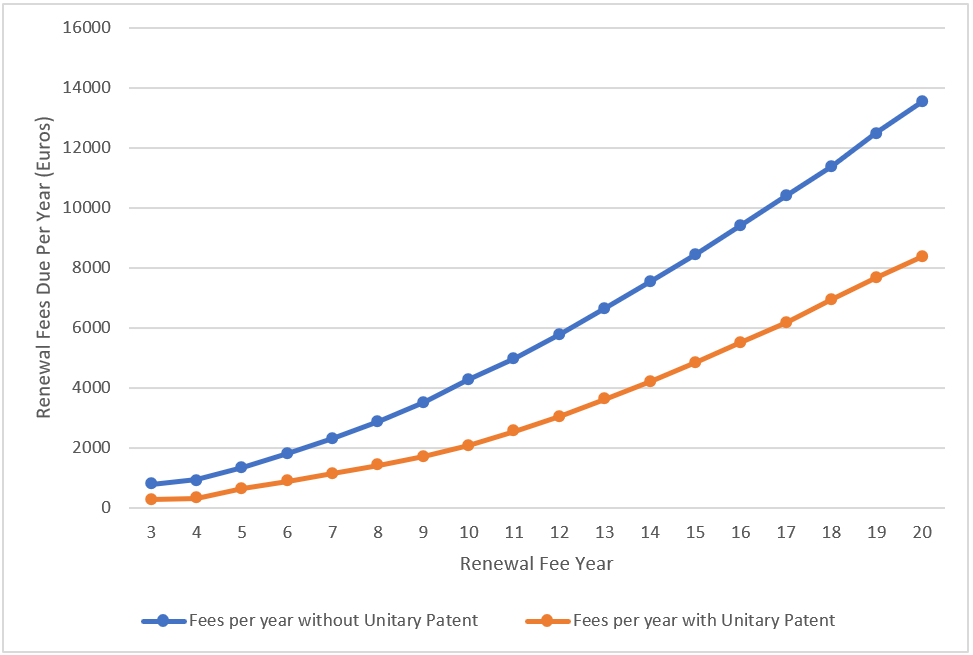
Given the widespread use of wind turbine technologies, manufacturers can consider the benefits of the Unitary Patent system, not only to maximise patent coverage for reduced cost, but to simplify enforcement of the patent should that ever be required.
Of course, no one strategy fits everything and there will be times when the Unitary Patent system is not appropriate.EIP can advise on the most appropriate strategy to fit the particular commercial objective.