National offices report increases in national patent applications throughout Europe: Is the EPO no longer “killing” the national offices?

No items found.
​
March 27, 2026
The Swedish National Patent Office (PRV) recently reported a 13 per cent year‑on‑year increase in national patent applications in 2025. A review of available data from across the EPO area suggests that this is not an isolated development. On the contrary, a similar trend appears to be emerging across much of Europe. In this article, we take a closer look at the numbers and consider what may bedriving this shift.

The numbers
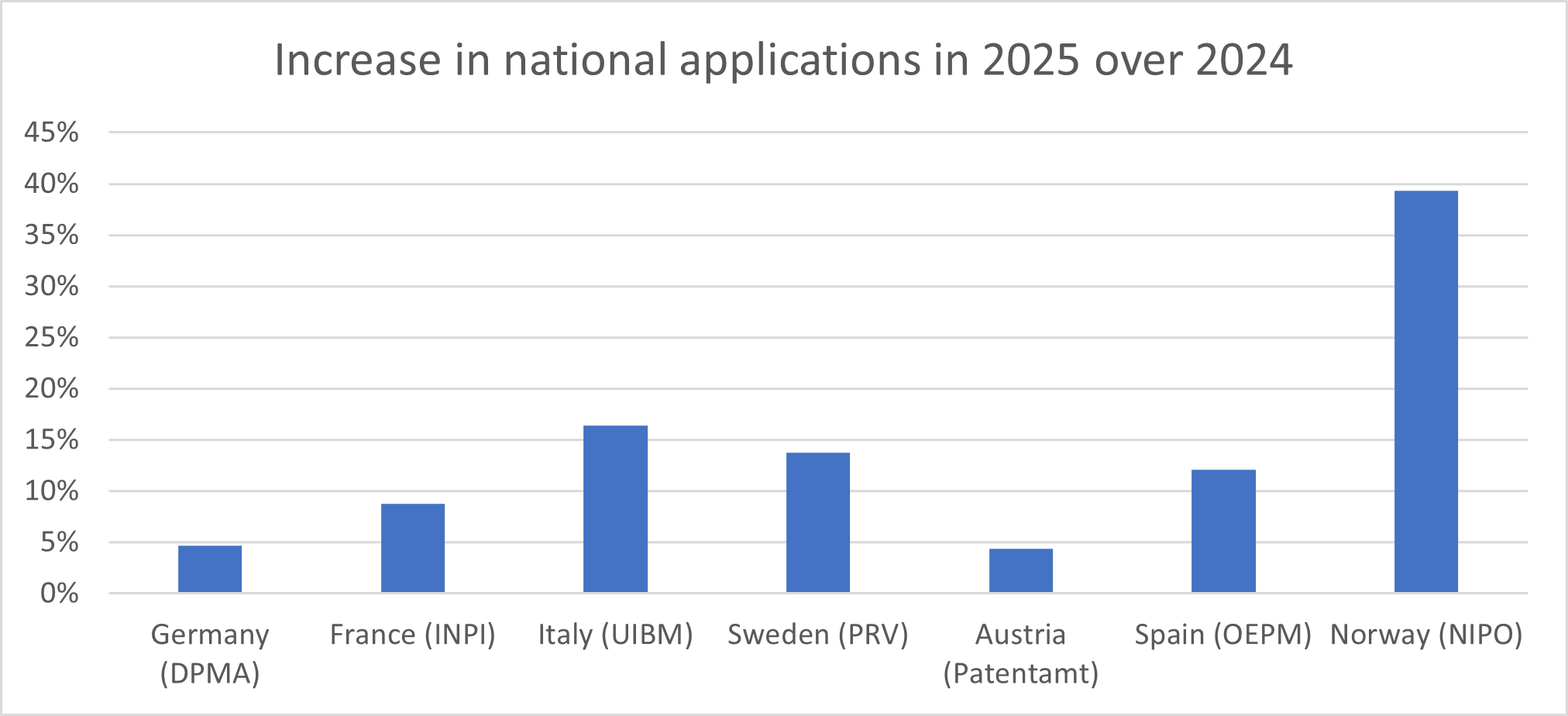
Increase in national applications

Let us start with the data. As of writing, figures for national patent applications in 2025 are available for Germany [1], France [2], Italy [3], Sweden [4], Austria [5], Spain [6] and Norway [7] [8]. All of these national offices reported an increase in filings, ranging from approximately 4 per cent at the Austrian Patent Office to almost 40 per cent at the Norwegian NIPO.

This marks a clear departure from the long‑term trend. Historically, national patent filings in Europe have shown a slow but steady decline. The graph below illustrates the number of patent applications, both first filings and PCT national phase entries, normalised against each country’s 2014 filing level.

For context, in 2014 the number of applications was 65,963 in Germany, 16,533 in France, 9,385 in Italy, 2,425 in Sweden, 2,363 in Austria, 3,178 in Spain and 1,627 in Norway. From 2014 onwards, most offices experienced a gradual decrease. While some saw early signs of recovery in 2023, 2025 stands out as the first year in which all of the reviewed offices show a clear increase.

Why now?

It is still too early to determine whether this development represents a lasting shift. More data over coming years will be needed to assess its statistical significance. Nevertheless, the fact that the increase appears across multiple jurisdictions suggests that common, Europe‑wide factors may be at play.

The German Patent and Trade Mark Office (DPMA), for example, notes strong growth in filings relating to computer technology and digital communications, which are fields characterised by extensive use of machine intelligence [2]. The DPMA also reports an increase in applications relating to electrical drives, a core technology underpinning electrification in transport, industry and power generation. This may be an early signal that the green transition is translating into increased patenting activity.
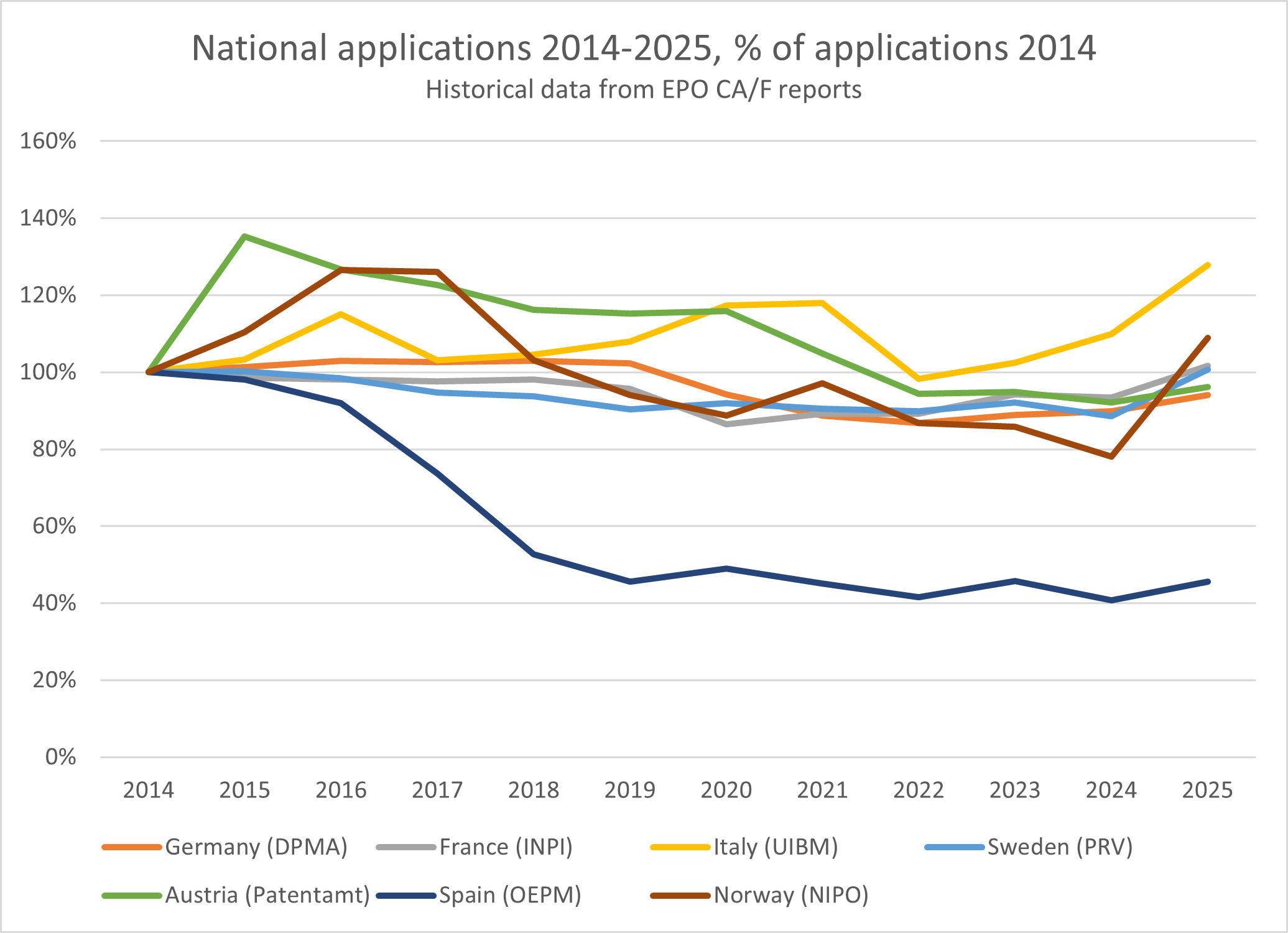
Historical data from EPO CA/F reports

In Italy and Austria, the respective patent offices highlight another driver: universities have become increasingly active filers [3] [5]. The incentives for academic researchers to protect intellectual property appear to be strengthening. In Italy, this trend may in part be linked to the abolition of the professor’s privilege in 2023, a reform that shifted ownership of employee inventions to universities and paved the way for more institutional filings [3].

PRV, meanwhile, points to the continued popularity of the EUIPO patent fund for small and medium‑sized enterprises, which has now been running for five consecutive years and provides financial support for IP protection [4].

The rise of self‑drafting and AI

Both PRV and the Norwegian NIPO also report a notable increase in individual inventors filing without professional representation. According to PRV, the number of applicants without representatives doubled in 2025 [4]. NIPO similarly observes a large number of applications that appear to have been drafted using AI tools [7].

From an inventor’s perspective, the appeal is obvious. Compared with the cost of professional representation, access to an AI chatbot is inexpensive, and national filing fees are often relatively low. In many cases, this reduces the upfront cost of seeking patent protection from several thousand euros to just a few hundred. Viewed in this light, the trend may be seen as a form of democratisation of the patent system.

There is, however, a less optimistic side. National offices report that AI‑drafted applications often lack clarity and contain formal deficiencies. Once substantive examination begins, such shortcomings can be difficult to remedy without professional assistance. Moreover, while AI tools may lower the entry barrier, they do not necessarily make the patent system more transparent for inventors, who may struggle to prompt these tools to address examiner objections effectively.

The growing use of AI as an ideation tool raises additional questions. Many jurisdictions have made it clear, for example in the DABUS cases, that artificial intelligence cannot itself be an inventor. At the same time, concerns remain around training data and its implications for novelty and inventive step, particularly where models are trained on data of uncertain provenance.

Conclusion

The recent increase in national patent filings points towards several positive developments across Europe. SMEs appear more engaged in protecting their innovations, activity in green and machine‑intelligence‑related technologies is rising, and access to the patent system may be broadening.

At the same time, the growth in AI‑assisted self‑drafting may increase the workload of national offices without necessarily leading to a corresponding rise in granted patents. In the longer term, this raises an interesting question: will the role of national patent offices evolve further, placing greater emphasis on education and guidance for individual inventors?

References

[1] DPMA, “Aktuelle Statistiken: Patente,” 24 February 2026. [Online]. Available:  https://www.dpma.de/dpma/veroeffentlichungen/statistiken/patente/index.html.  [Accessed 23 March 2026].

[2] INPI, “INPI Key  Figures 2025,” 03 February 2026. [Online]. Available:  https://www.inpi.fr/en/a-la-une/chiffres-cles-inpi-2025. [Accessed 23 March  2026].

[3] UIBM, “Mimit: Report  Brevetti +18,2% nel 2025,” 02 March 2026. [Online]. Available:  https://www.mimit.gov.it/it/notizie-stampa/mimit-report-brevetti-18-2-nel-2025.  [Accessed 23 March 2026].

[4] PRV, “Trendbrott i antal ansökningar till PRV,” 12 March  2026. [Online]. Available:  https://www.prv.se/sv/om-oss/nyheter/okning-av-antalet-ansokningar-till-prv/.  [Accessed 23 March 2026].

[5] Österreichisches  Patentamt, “Österreich erfindet wieder deutlich mehr: Patentamt verzeichnet  Anstieg bei Anmeldungen,” 05 March 2026. [Online]. Available:  https://www.ots.at/presseaussendung/OTS_20260305_OTS0042/oesterreich-erfindet-wieder-deutlich-mehr-patentamt-verzeichnet-anstieg-bei-anmeldungen.  [Accessed 23 March 2026].

[6] Elzaburu, “Récord de  solicitudes en 2025: las cifras clave de Propiedad Industrial en España,” 03  March 2026. [Online]. Available:  https://elzaburu.com/record-solicitudes-propiedad-industrial-2025-oepm/.  [Accessed 23 March 2026].

[7] Patentstyret, “Økning i norske patentsøknader,” 25 February  2026. [Online]. Available:  https://kommunikasjon.ntb.no/pressemelding/18812322/okning-i-norske-patentsoknader?publisherId=4739852&lang=no.  [Accessed 23 March 2026].

‍

‍

The Latest Thought Leadership pieces in the Content Hub

No items found.
Stay in the Know

The Patent Strategist

Get expert insights and the top patent stories delivered straight to your inbox.

Heading
This is some text inside of a div block.

Latest Insights

Showing 0 of 100
The UPC After Three Years: From Experiment to Enforcement Forum
15 July 2026
1,282 cases filed at the UPC in three years: infringement actions have surged while revocation filings stayed flat, easing fears the Court would become a European patent graveyard.
Choosing your SEP battleground: UPC, Germany or UK?
07 June 2026
Choosing the right venue for SEP litigation can significantly influence the outcome of FRAND disputes. This article compares the UPC, German and UK courts, examining their approaches to injunctions, FRAND defences, rate-setting and enforcement. It highlights the strategic advantages of each jurisdiction and explains why many SEP owners are increasingly turning to the UK and UPC as part of their European enforcement strategy.
Synthetic Lethality & AI: IP Strategy in Oncology
26 May 2026
This article explores the resurgence of synthetic lethality in precision oncology, highlighting how AI and machine learning are accelerating the discovery of new therapeutic targets. It also examines growing clinical activity, investment, and the evolving intellectual property challenges shaping this emerging field.
Inside the Visser AI Launch Party
20 May 2026
EIP has officially launched Visser AI®, our hybrid intelligence service for patent drafting and prosecution. Watch the launch film from our event at The Boundary in Shoreditch, and discover how our team of European and US patent attorneys — working with the Patently AI platform , delivers faster, lower-cost work at the EPO, USPTO and beyond.
Protecting Your Startup: Five Intellectual Property Mistakes to Avoid
20 May 2026
Early‑stage startups often focus on product development and fundraising, but overlooking intellectual property (IP) can seriously damage long‑term value. This article explores five common IP mistakes startups make, with a particular focus on patents. It covers the risks of filing patents without professional advice, making public disclosures too early, failing to put enforceable contracts in place with third parties, misunderstanding what patent rights actually provide, and neglecting to develop a clear IP strategy. By highlighting these pitfalls and offering practical guidance, the article helps startups protect their innovations, strengthen their commercial position, and improve their prospects with investors.
Technology, Patents, and Sport
13 May 2026
VAR, goal-line tech, AI 3D player avatars, wearable trackers, the technology reshaping the 2026 World Cup and elite sport rests on a patent system that makes the R&D investment behind it worth taking.
Patents or Trade Secrets? When to Patent in Deep Tech Innovation
11 May 2026
Deep tech companies face unique IP challenges due to long development cycles, high upfront investment, and complex technologies that combine products and processes. This article explores when patents, trade secrets, or a combination of both offer the strongest protection. It explains how factors such as detectability, reverse engineering risk, disclosure to third parties, and employee mobility should shape IP strategy decisions. While patents are often best suited to externally visible or licensable technologies, trade secrets can be highly effective for internal processes and know‑how that deliver performance or cost advantages.
Is Your AI Conversation Privileged?
08 May 2026
Recent US court decisions have, for the first time, tested whether conversations with AI tools can be protected by legal privilege. In United States v. Heppner, a court held that documents generated by a defendant using a public AI platform were not protected by attorney‑client privilege, largely because the AI was not used within a lawyer‑directed relationship and the platform’s terms allowed data retention and disclosure. By contrast, in Warner v. Gilbarco, another court found that AI‑assisted materials created by a self‑represented litigant were protected under the work‑product doctrine, which has a more forgiving standard for waiver.
The evolution of nucleic acid sequencing and what it means for Genomics and IP
27 April 2026
This article outlines the evolution of nucleic acid sequencing, from early Sanger methods to next‑generation and long‑read technologies. The journey from deciphering individual DNA strands to sequencing entire genomes in hours represents one of biotechnology's most impressive transformations. The first human genome, completed through the Human Genome Project, took around 13 years to sequence and cost billions of dollars, whereas modern sequencing methods can now deliver a genome in hours for a few hundred dollars. For those interested in patents and life sciences, understanding the technical evolution of sequencing methods offers insights into how fundamental scientific advances translate into valuable patent portfolios.
World IP Day: The big ideas shaping IP's fastest-moving fields
24 April 2026
For World IP Day, we asked experts of EIP’s five growth areas: Uniphy, Ampliphy, Stratiphy, Codiphy and Quantiphy, to share a quick insight on innovation, IP trends, and what excites them about the future. Each responded to a single, focused question reflecting the role their team plays across EIP.
Meet the EIP team heading to INTA 2026 in London
23 April 2026
INTA's Annual Meeting is coming to London. From 2–6 May 2026, the ExCeL will host more than 10,000 trade mark and IP professionals from over 100 jurisdictions — five days of sessions, side events, and the kind of corridor conversations that turn into lasting working relationships.
National offices report increases in national patent applications throughout Europe: Is the EPO no longer “killing” the national offices?
27 March 2026
National patent offices across Europe have reported a marked increase in patent filings in 2025, breaking with a long‑standing downward trend. Data from Germany, France, Italy, Sweden, Austria, Spain and Norway point to growing activity driven by digital technologies, electrification and increased university participation. At the same time, offices report a rise in self‑drafted and AI‑assisted applications, which may lower barriers to entry but also raise concerns about application quality and examination efficiency.
Make your bio(pharma) IP investment ready
22 March 2026
This recap of our LinkedIn Live series focuses on helping (bio)pharma businesses make their IP investment‑ready. Across three sessions, experts will discuss building resilient IP portfolios, making strategic IP decisions ahead of funding rounds, and what the evolving 2026 (bio)pharma landscape means for long‑term IP strategy.
Are professional guidelines making Patent Attorneys too cautious on AI?
19 February 2026
As AI use accelerates in patent practice, many European patent attorneys remain cautious due to professional AI guidelines from the epi. This article argues those guidelines are not a barrier, but a baseline for responsible use.
Beyond CRISPR: Precision to Platform
23 January 2026
Gene editing is entering a new phase, moving beyond CRISPR-Cas9’s breakthrough but costly, bespoke therapies toward more precise and scalable platforms. While CRISPR-based treatments like Casgevy have proven clinical success, they remain expensive and entangled in ongoing patent disputes over foundational IP. Next-generation tools such as base editing and prime editing avoid double-strand DNA breaks, enabling more accurate corrections and broader therapeutic potential. The field’s focus is now shifting to disease-agnostic platforms that can be adapted across many conditions, improving access and efficiency.