Research underlying Nobel prize in chemistry has sparked innovation and patent filings

​
December 2, 2025

Imagine a material that can capture water vapour from desert air during the night and then release water when the sun rises – this sounds like science fiction but has become a reality by the research made by Susumu Kitagawa, Richard Robson and Omar M. Yaghi, awarded the Nobel prize in Chemistry 2025.

This year’s laureates have created a new type of molecular entities, metal-organic frameworks, MOFs, with enormous potential. Besides water harvesting, future application areas include e.g. gas storage, water purification, carbon dioxide capture, and battery technology. The number of patent publications relating to MOFs has risen from close to zero in 2005 to near 4,000 in 2024.

MOFs – soon a term on everyone’s lips

Metal-organic frameworks, MOFs, are materials in which metal ions (or clusters) are connected by organic linkers to create a 3D network containing a vast number of well-defined cavities. The cavities can act as reservoirs for guest molecules that can enter and exit from the surrounding environment. The seemingly endless combinations of the building blocks (metal and linker) allow precise tailoring of MOF properties, such as cavity size and chemical functionality, to suit specific applications.
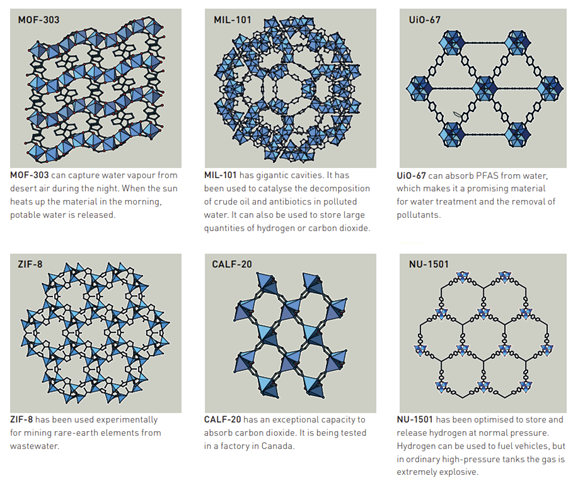
Source: © Johan Jarnestad/The Royal Swedish Academy of Sciences

MOFs are highly porous materials with exceptionally large internal surface areas. One gram of a MOF could have an internal surface area as big as a football field! This makes MOFs better adsorbents than previously known porous materials, such as zeolites or activated carbon.

MOFs are innovation drivers

The MOF technology has paved the way for a flood of innovations in various industrial sectors, such as e.g., chemical industry, healthcare & pharmaceuticals, energy, and environmental remediation.

The vast innovative activity is mirrored by the steep increase in patent filings in the MOF field. China shows the highest patent filing activity, followed by the US and South Korea. A large part of the patent application filings stem from universities, but also major companies like BASF and ExxonMobile can be found among the top filers.
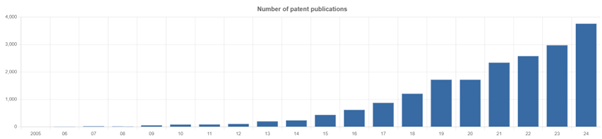
Credit: CAS Content Collection (Michael McCoy Chemical & Engineering News, May27, 2025: “Eye on Patents: Powering EVs and capturing CO2 with metal-organic frameworks”)

Laureates are patent-conscious

Considering the steep rise of patent applications relating to MOFs, it is evident that this field attracts a lot of interest, both in academia and industry. The Nobel laureates themselves also have their research work protected by several patents.

Omar M. Yaghi (together with fellow inventors) has a patent relating to a moisture harvester containing a MOF as water capturing material. This allows liquid water to be collected, also from dry air, e.g. in desert environments. The collected water is suitable for human consumption and can also be used for irrigation of crops. It is easy to envision the impact this invention may have for populations in areas where water supply is scarce.
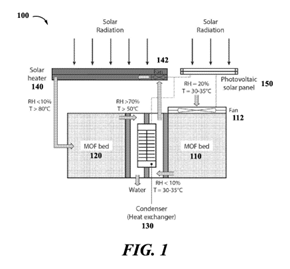
(Figure 1 from EP 3837399 B1 – representative patent family member)

Susumu Kitagawa (and fellow inventors) holds a patent relating to a method for separating and storing highly unstable per- and polyfluoroalkyl substances (PFAS), such as tetrafluorethylene, through adsorption to a MOF. PFAS are widely used industrially, and the possibility to separate, store and transport these toxic and hazardous molecules in a safe way is of great value for humans and the environment.
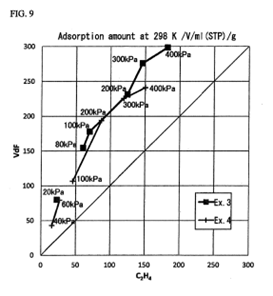
(Figure 9 from EP 3339281 B1 – representative patent family member)

The future is bright

The MOF science is still new, and the broad use and application of MOFs in an industrial scale are yet to be explored. In times of climate change and sustainability challenges, they at least bring a fair amount of hope and expectations to the table.  

The scientific community is excited that the basic research behind MOFs is being awarded the Nobel prize, and Susumu Kitagawa, Richard Robson and Omar M. Yaghi have surely inspired to continued ground-breaking research and innovation. Who would not want to join the solemn Nobel prize ceremony and dinner in beautiful Stockholm?

‍

The Latest Thought Leadership pieces in the Content Hub

The people, physics and patents of the 2025 Nobel prize
December 9, 2025
The 2025 Nobel Prize in Physics recognised John Clarke, Michel H. Devoret, and John M. Martinis for proving macroscopic quantum tunnelling in electric circuits, a breakthrough that enabled quantum computing. Their pioneering research led to hundreds of patents, including innovations in MRI and quantum technology, highlighting the real-world impact of their discoveries.
Stay in the Know

The Patent Strategist

Get expert insights and the top patent stories delivered straight to your inbox.

Heading
This is some text inside of a div block.

Latest Insights

Showing 0 of 100
Confidentiality at the UPC: What litigants need to know
21 January 2026
This article explains how the Unified Patent Court approaches confidentiality in litigation, outlining the procedures for restricting access to sensitive information, how confidentiality clubs are formed, and when hearings may be held in private. It highlights key case law shaping these rules, the balance between fair trial rights and protection of commercial data, and the penalties for breaches. Practical guidance is provided to help parties navigate applications, manage confidential documents, and understand what to expect throughout UPC proceedings.
EPO fees are going up in April 2026: Plan ahead now
19 January 2026
The European Patent Office will introduce a fee increase of roughly 5% from 1 April 2026, affecting search, examination, designation and renewal fees. Filing, excess page, opposition and appeal fees remain unchanged. Some costs—such as renewal fees—can be paid up to three months early, allowing applicants to secure the current lower rates. EIP recommends reviewing your portfolio ahead of the deadline.
The contentious role of intellectual property in cryptographic standardisation
12 January 2026
This article explores how intellectual property rights affect the development and adoption of post-quantum cryptography standards. It highlights NIST’s proactive approach to patent licensing for new algorithms, reviews historical cases like RSA and ECC, and discusses the importance of clear IP terms for widespread cryptographic adoption.
System architecture in quantum computing – history repeating itself?
24 December 2025
This article explores the evolution of system architecture in quantum computing, drawing parallels with the early days of classical computing. It discusses the current challenges in quantum hardware, the emergence of quantum instruction set architectures (ISAs), and the potential for a RISC vs. CISC debate similar to that in classical computing. The piece highlights opportunities for innovation and intellectual property, suggesting that the choices made now could shape the future landscape of quantum technologies and licensing.
Strategic licensing: Turning IP into commercial value
09 December 2025
In today’s competitive landscape, effective commercial licensing strategies are essential for unlocking the full value of intellectual property. This article explores four critical pillars: understanding intellectual property as a property right, the fundamentals of licensing intellectual property rights, structuring successful joint ventures and best practices for intellectual property rights management. Whether you’re navigating new markets or scaling established innovations, these tips provide a roadmap for protecting, leveraging and maximizing your IP assets.
The people, physics and patents of the 2025 Nobel prize
09 December 2025
The 2025 Nobel Prize in Physics recognised John Clarke, Michel H. Devoret, and John M. Martinis for proving macroscopic quantum tunnelling in electric circuits, a breakthrough that enabled quantum computing. Their pioneering research led to hundreds of patents, including innovations in MRI and quantum technology, highlighting the real-world impact of their discoveries.
Vision 2035: The need for Innovation to meet ambitious targets set by the UK’s new critical minerals strategy
03 December 2025
The UK’s Critical Minerals Strategy 2025 sets ambitious targets to secure essential minerals for key industries by boosting domestic production, recycling, and innovation. The article highlights the vital role of intellectual property (IP) in supporting technological advances, encouraging collaboration, and strengthening the UK’s supply chains for a sustainable future.
Research underlying Nobel prize in chemistry has sparked innovation and patent filings
02 December 2025
The 2025 Nobel Prize in Chemistry recognised the creators of metal-organic frameworks (MOFs), innovative materials with huge potential for water harvesting, clean energy, and environmental solutions. Their work has sparked a surge in global patent activity and new industrial application.
UKIPO fee increases from April 2026: What it means for your IP strategy
25 November 2025
Provisional and interim injunctions both refer to temporary court orders granted before a full trial, aimed at preserving the status quo or preventing harm. In UK law, “interim injunction” is the standard term, while “provisional injunction” is less common and typically used in international contexts. Both serve the same purpose: urgent relief until the case is fully heard.
Sustainable models: content licensing for generative AI training
21 November 2025
It is fair to say that no technology in recent times has created so much excitement and controversy as generative AI, and in particular Large Language Models (LLMs). Generative AI companies and their backers have their sights on generating billions, if not trillions of dollars, directly or indirectly from their models. Models which, in the vast majority of cases, are trained on original works without permission from, or payment to, their authors. The works used for training are primarily obtained by scraping the open web, a uniquely vast repository of publicly accessible knowledge and information, constantly updated to reflect the latest developments in human knowledge and culture.
What should you look to protect in a (bio)pharma IP strategy?
18 November 2025
UPC takes strict approach on costs reimbursement
30 October 2025
Insulet v. EOFlow UPC_CFI_773/2025 and UPC_CFI 774/2025 (Milan CD), decision of 15 October 2025[1] The dispute began when Insulet sought a provisional injunction against EOFlow to prevent...
UPC Considers but does not decide exhaustion of rights in relation to consumables
30 October 2025
Brita v. Aquashield UPC CFI 248/2024 (Munich LD), decision of 22 August 2025[1] UPC CFI 564/2024 (Munich LD), decision of 16 October 2025[2] Brita sued Aquashield and others for infringement of...
UPC Infringement Actions: Is Speed Meeting Expectations?
23 September 2025
The Unified Patent Court promised simplified and faster patent litigation across Europe. Two years in, we look at whether it’s delivering on that promise. For patent holders and defendants alike, the duration of infringement actions can significantly impact market strategies, investment decisions, and competitive positioning. In this article, we set out an in-depth analysis of how the court’s procedural rules are shaping the pace of litigation. By examining key milestones—from the filing of an infringement action to the issuance of a final judgment—we assess whether the UPC is delivering on its promise of efficiency.
Emerging Practice Points from the UPC
02 September 2025
We have been keeping a close eye on the decisions coming out of the UPC and as the court starts to establish itself a number of practice points are starting to emerge.