Seizing a greener future for the UK

The announcement this week from the UK Government of funding for new Carbon Capture and Storage (CCS) schemes has had a mixed reception. It's a shame the announcement was hand-in-hand with new oil and gas licenses, as if it's a free pass for increased fossil fuel emissions.
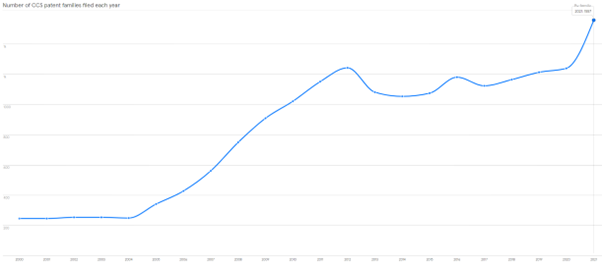
Of course it isn't a free pass, but the potential for UK CCS is huge and the government is right to pursue it. There's enormous development needed to reach the 20 to 30 million tonnes captured per year target by 2030. (For comparison, in 2022 the UK's CO2 emissions were 331.5 million tonnes). If the technology can work on that scale by the 2030 deadline, it opens up much opportunity. The latest patent filing data shows that industry is stepping up to the challenge, with more patents for CCS filed than ever before in 2021**. What's more, there's been a huge increase in filings in China. Perhaps this is not surprising, considering how much coal generation China is still using.
I'm looking forward to the benefits of a CCS future. First, the "low hanging fruit" is lowering the CO2 emissions of generating electricity from Gas. Gas is still a huge part of the energy mix in the UK. With effective CCS, gas could continue to provide energy diversity and security, for those cloudy, still days when solar and wind can't deliver. Crucially, gas generation is not limited by how sunny or windy it is. It can allow the grid to respond to demand peaks without costly energy storage schemes or deliberately building overcapacity into the renewable provision. Gas with CCS might even be overall less environmentally damaging than some alternatives too, especially against building high capacities of battery storage purely to smooth the demand curve. What's more, in the UK, gas power stations tend to be situated close to where gas connections make landfall, ideally locating them for carbon capture schemes out to depleted oil and gas fields.
Looking further ahead, the idea of sucking CO2 from the atmosphere more generally is attractive. So attractive it's often criticised as providing no inventive to reduce CO2 emissions. I disagree, with such huge potential storage in all the UK's depleted oil and gas fields, there's the possibility that a future UK could become a carbon sink with genuinely negative carbon emissions.
**Patent filing activity is a good indicator of the degree of innovation. Looking at new patent families filed up to 2021, and which were classified for CO2 capture and storage, shows a plateau from 2012 to 2020, with a sharp rise in 2021. I've only considered data to 2021 because patent applications are published 18 months after filing, so 2021 is the latest complete year data is available for. The graph below is from Patently.com.