Fintech

Fintech moves quickly. Companies build new products at pace, often in crowded markets and under tight regulatory pressure. Protecting those ideas - and navigating the risks posed by others' rights - is essential.
Fintech innovation often mixes software, data, payments, security, risk modelling, and AI. That creates unique challenges: what can be patented, where the risks sit, and how to build an IP strategy that keeps up with changing technology and regulations.
Our team delivers integrated intellectual property and legal advice for Fintech businesses. We help you understand the issues and make informed decisions that support your commercial goals.
“Mark Lubbock is a high-level operator and tremendously impressive in negotiations.”

Legal Layer®: guiding you to the best outcome
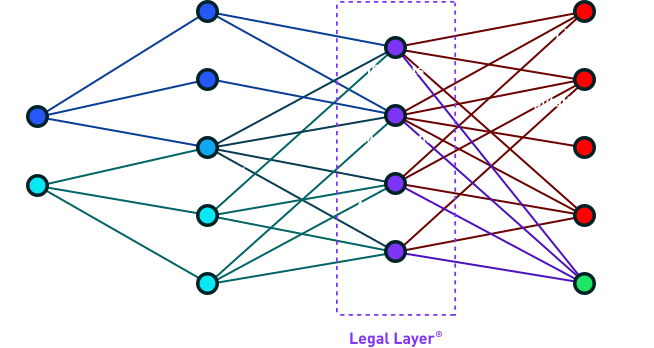
Our team's fully-connected approach can help you to understand how your dealings with data and algorithms engage different aspects of IP and related areas of law. In this way, we serve as a “Legal Layer” to help you optimize outcomes for your business.
Paths through the neural network represent how certain features of data and algorithms can engage different legal considerations in the Legal Layer. Our Codiphy team considers these all together to optimise the outcomes for your business.
Click the buttons to show some examples of the many paths through the network.
Some AI models are trained on data scraped from publicly-available sources. This may have legal implications. For example, training an AI model using copyright works without obtaining a licence from the rightsholder could result in litigation and/or reputational damage. AI regulations will also play a role. For example, the EU AI Act will oblige General Purpose AI providers to publish summaries of training data and to respect opt-outs from data scraping. Otherwise, they could face penalties under the Act.

Proprietary algorithms may involve IP that can be protected, for example using trade secrets or patents. Competing factors need to be considered to optimise protection of that IP. For example, trade secret protection may extend an early-mover advantage, but will be lost if technical information is publicly leaked. Patents can provide protection even if the technical information is later published or if someone else develops the same idea independently, but filing a patent application for an idea that isn’t patentable may result in a loss of IP. An effective IP strategy will consider these factors and others to maximise the value in the IP.

Original code is protected by copyright, which may be licensed for others to use, for example under an open-source licence. Non-compliance with the obligations of an open-source licence may result in litigation and/or reputational damage. If you are considering releasing code under an open-source licence, it is important that this decision fits in with your business model and wider IP strategy, and that the licence you use supports these. Attempting to change licence terms after release can be difficult or impossible, and can cause reputational damage in the eyes of the open-source community.

AI models may be trained on, or may subsequently process, personal data that relates to an identified or identifiable natural person (including personal data that is publicly accessible). This may have legal implications if the training/processing is not compliant with data protection obligations. The party controlling the processing could face regulatory penalties including orders to stop the processing or using the AI model, litigation between the user and the controller, and/or reputational damage. Providers of AI systems should consider the principle of ‘privacy by design’, as well as ensuring contractual provisions are in place to mitigate the legal risk.

Our innovative combination of experienced specialists
Our advisors bring together a wealth of experience in intellectual property strategy and commercial law within the Fintech field. Combining technical expertise with legal and business knowledge, we understand the importance of using IP to generate business value and the complexities of technology and supply chains. We provide practical, commercially focused advice to help your business thrive in a rapidly evolving landscape.



Discover our featured insights
Stay informed with the latest Consulting developments and the global IP landscape. Tune into our EIP Talks podcast, explore expert insights and browse our published articles and thought leadership, all designed to keep you ahead in the world of intellectual property.
Strategic licensing: Turning IP into commercial value
Thinking about IP from day one: strategic considerations for deep tech startups
Protecting Your Startup: Five Intellectual Property Mistakes to Avoid
Find your match
We work closely with clients, from C-suite to IP teams, to unlock the full potential of their intellectual property. Our integrated team of litigators, patent attorneys and commercial IP experts helps drive business growth by protecting and strategically leveraging patents.
Search by expertise, industry or location to find the right team for your business.