Mammaoet Holding B.V. v P.T.S. Machinery B.V.

(UPC_CFI_16/2025)
Procedural Order of the Court of First Instance of the Unified Patent Court delivered on 22 January 2025 regarding the preserving of evidence
This is a decision on the preservation of evidence prior to commencement of proceedings on the merits of alleged indirect infringement of Mammoet's patent by P.T.S. Machinery.
Mammoet's patent, EP 4171996B1, with a priority date of 29 June 2020, relates to a modular trailer system for lifting and transporting large and/or heavy objects. This involves two trailer modules with a jack system in between attached to the first module, each module and jack consisting of specific parts.
In November 2020, Mammoet commissioned six jack cradles with specific features for use in the patented invention from P.T.S. Machinery, and provided confidential drawings to P.T.S. Machinery in order to enable their construction. In November 2024, the general director of P.T.S. Machinery posted a photograph of a jack cradle which Mammoet believes has the same features as the commissioned jack cradle, and therefore could (and Mammoet believes will) be used in the patented invention.
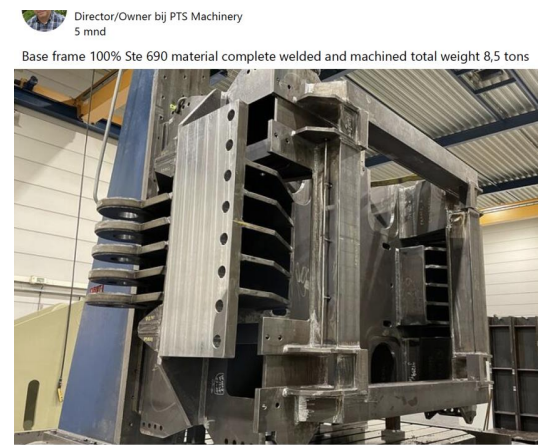
Mammoet alleges that the production and sale of the pictured jack cradle would be an indirect infringement of their patent, as the jack cradle is an essential element of the invention, and P.T.S. Machinery was aware of the potential use of the jack cradle in an invention such as Mammoet's given the earlier commission.
Mammoet further alleges that any purchaser from P.T.S. Machinery of such a jack cradle that subsequently incorporates it into a modular trailer system would be a direct infringement.
Mammoet wrote a cease-and-desist letter to P.T.S. Machinery, following which P.T.S. Machinery admitted that it produced, offered for sale and sold the pictured jack cradle to at least one party in a contracting country to the UPCA, but denied that this constituted infringement and refused to divulge the identity of the purchasing party.
The Court found it had exclusive jurisdiction as Mammoet had applied for unitary effect for its patent, and that the Hague Local Division was a competent court as it is the same court that Mammoet intends to start proceedings on the merits. It also found that the formal requirements were met and the fees were properly paid. No protective letter had been filed by P.T.S. Machinery.
The Court further found that Mammoet's evidence, in particular the evidence regarding P.T.S. Machinery's prior knowledge of the patented invention, is sufficient to support its claim for indirect infringement at a preliminary stage.
The Court determined that P.T.S. Machinery's response to Mammoet's cease-and-desist letter gave sufficient indication that there was a demonstrable risk of evidence being destroyed or ceasing to be available, that the matter was urgent, suitable for ex parte determination, and that the balance of interests favours Mammoet.
Mammoet was ordered to pay security of €20,000.00 for legal costs and other expenses and compensation that could be incurred by P.T.S. Machinery by reason of their order.
The Court ordered the following:
- Mammoet may obtain a detailed description of the pictured jack cradle, the physical seizure of photocopies of technical and promotional documentation materials related to the pictured jack cradle, and the presentation in print or copy of digital media and data relating to the pictured jack cradle.
- The order will be carried out by a bailiff accompanied and/or assisted by a technical expert, who will be appointed as a custodian of anything seized if needed, and no employee or representative of Mammoet would be allowed to be present.
- The technical expert should produce a written report on the measures of preservation of evidence
- If Mammoet does not bring action leading to a decision on the merits within a month from the date of the written report, the measures to preserve evidence are revoked.