UPC Court of appeal issues final decision, despite no finding on infringement at first instance

Rematec GmbH & Co KG v Europe Forestry B.V.
UPC_CoA_302/2025 and UPC_CoA_305/2025, decision of 17 February 2026 [1]
The Court of Appeal overturned the Mannheim local division’s decision to revoke the patent and dismiss the infringement claim, finding the patent valid and infringed and deciding on remedies without remitting the case to the Court of First Instance. As a rule, Article 75(1) UPCA requires the Court of Appeal to issue a final decision, even if it is necessary for it to decide on issues that were not decided at first instance.
Background
In 2023, Rematec GmbH & Co. KG (“Rematec”) instigated proceedings against Europe Forestry B.V. (“Europe Forestry”) in the Mannheim local division for infringement of EP 2 548 648. Europe Forestry B.V. subsequently counter claimed for revocation, and, in a January 2025 decision, the Court of First Instance decided in their favour, declaring the patent invalid and, consequently, dismissing the infringement claim without further analysis.
The First Instance Decision
Claim 1 of EP 2 548 648 is directed to a “Mill for the grinding of grist, in particular woodchips”, and defines a mill in which (inter alia) the feed-in and discharge openings to the grinding area “enable essentially radial feed-in and discharge of grist relative to the axis of rotation”, and are each arranged in the lower region of the grinding area. An example of a mill having this arrangement is shown in Figure 1 of the patent, which is reproduced below.
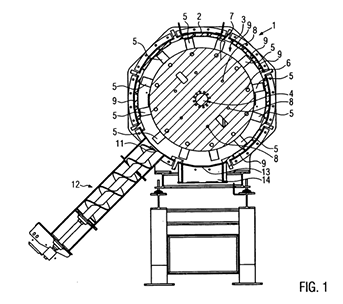
As can be seen from this drawing, the feed-in opening (11) and the discharge opening (13) are both positioned in the lower region of the grinding area and provide feed-in and discharge directions that are oriented substantially radially with respect to the axis of rotation of the rotor (3). The advantage of such an arrangement over an arrangement in which wood is fed-in at the top is that the wood travels further inside the machine and so has more time to be ground into smaller chips before being discharged at the bottom.
However, it was the requirement that the feed-in and discharge openings enable essentially radial feed-in and discharge of grist that was the key feature for validity assessment, with the Mannheim local division finding that this feature was found in Figure 3 of prior art reference D3 (DE34114567) (reproduced below), leading to a finding of a lack of novelty.
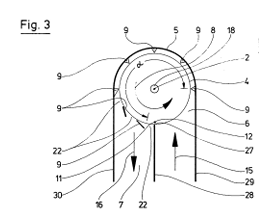
In their assessment, the local division interpreted this claim feature broadly considering that:
i. A strictly radial direction in a geometric sense is not required;
ii. There is no requirement that all of the material being processed should be fed in and discharged in an essentially radial direction; and
iii. The feed-in and discharge openings need only permit radial inflow and outflow, and the claim does not require that the material actually be transported in an essentially radial direction through the openings.
Following this interpretation, the local division found that the claim feature was satisfied by Figure 3 because the portion of the material that enters and leaves the mill directly adjacent to the centre partition between the input and output channels would be doing so in a substantially radial direction to the centre point of the circle in the grinding area and, in any case, the claim only requires that the openings allow for such essentially radial transit into and out of the grinding area to occur, which, in their view, was clearly possible.
As the other claim features were also considered to be disclosed in this figure, the claim was considered to lack novelty over D3.
Having made this finding and considering that none of the Auxiliary Requests on file could rescue validity, the infringement action was dealt with in a single sentence, indicating that, in view of their findings on validity, the infringement claim can be dismissed without further consideration.
The Court of Appeal’s approach
The Court of Appeal preferred a narrower interpretation of the claim, which they considered to be consistent with the description and drawings of the patent at issue, and made reference to the recent UPC Court of Appeal (NanoString vs 10x Genomics, UPC_CoA_355/2023) and EPO EBA (G1/24) decisions that indicate that the description and drawings must always be taken into account when interpreting a patent claim.
Although the Court of Appeal agreed with the local division’s first conclusion that a strict geometric interpretation of the direction of travel is not required, they did not agree that the claim feature can be satisfied by only a portion of the grist entering and leaving the mill in an essentially radial direction, or that the claim only requires that the openings are suitable to allow material to enter and leave in an essentially radial direction, but does not require that this actually occurs. The latter of these points was key to the decision on appeal.
Referring to the discussion of the prior art in the patent at issue, the Court of Appeal noted that the patent differentiates the essentially tangential orientation of the discharge openings in one prior art document (DE3020955 (D8)), from the essentially radial direction used in a second document (EP0164489 (D9)). In the Court’s view, it would be theoretically possible for the grist to pass through the openings in the D9 reference in a radial direction, but, in the language of the patent, the tangential direction of travel is enabled by the feed-in and discharge openings. From this, it follows that the claim feature should be interpreted as requiring that an essentially radial direction of feed-in and discharge is achieved by means of the corresponding configuration of the feed-in and discharge openings.
As the feed-in and discharge openings in Figure 3 of D3 are not oriented essentially radially with respect to the axis of rotation, the Court found that they do not enable essentially radial feed-in or discharge as required by Claim 1 and therefore concluded that the claim is novel. As no suggestion to combine an essentially radial direction of feed-in and discharge with both the feed-in and output openings being positioned in the lower region of the grinding area was found in D3, the Court of Appeal also found the claim inventive in view of this document.
The Court of Appeal also concluded that the claims were valid in view of the other prior art references on record.
Sufficiency of Dependent Claims
In addition to their prior art-based invalidity contentions, Europe Forestry also argued that Claims 6 and 8 of the patent lacked sufficiency of disclosure. However, the Court of Appeal found that no decision on this issue was required due to a lack of legal interest. In the Court’s view, as these claims depended on Claim 1, which necessarily therefore provides a scope of protection that encompasses their subject matter, it was not necessary for them to provide a specific ruling on this point.
This approach is contrary to the EPO’s approach to assessing claim requests, particularly during Opposition proceedings, in which a finding that any claim contravenes any of the relevant requirements of the EPC causes the whole claim set to fall. However, as the Court found that Claim 1 was valid and infringed, they presumably felt that a finding of invalidity for a dependent claim would not change the outcome of the case. Such an approach is consistent with the UPC’s aim to efficiently dispose of disputes, and perhaps highlights the different purposes of Court proceedings, and the EPO’s Opposition procedure, in which the role of the EPO is to ensure that the patents that it has granted are compliant with the EPC rather than dispute resolution in a broader sense.
Infringement, and the requirement for the Court of Appeal to issue a final decision
The Court of Appeal then went on to find Claim 1 and Claim 15 (a related method claim) infringed, despite the lack of a decision, or any analysis, on this point from the Court of First Instance.
In deciding on their competence to issue a final decision on infringement, the Court made reference to Article 75(1) UPCA, which they summarised as indicating that when overturning a first instance decision, the Court of Appeal must, as a rule, issue a final decision, which would, in the present circumstances, require them, as a rule, to also decide the infringement claim.
Further support for this position is provided in Rule 242.2(b) of the Rules of Procedure of the UPC, which states that “It shall not normally be considered to be an exceptional circumstance justifying a referral back that the Court of First Instance failed to decide on an issue which it is necessary for the Court of Appeal to decide on appeal”. In the Court’s view, the fact that the first instance finding of invalidity obviated the need for the Court of First Instance to make a finding on infringement, would not, as a rule, be considered to be an exceptional circumstance justifying a referral back. In view of this, and with no other grounds that might have amounted to the required exceptional circumstances being advanced by the parties, the Court of Appeal considered that they were required to also proceed with issuing a final decision on infringement.
Remedies
The Court of Appeal issued a final injunction against Europe Forestry, and also ordered several other remedies, including damages incurred since 8 November 2014 (the date of publication of the patent at issue) and delivery up and destruction of infringing products.
However, they declined to make an order for the decision to be published at Europe Forestry’s expense under Article 80 UPCA. Rematec had requested that it should be authorised to publish the decision in five national newspapers and five specialist publications, with Europe Forestry being required to reimburse the costs. However, the Court indicated that, in addition to a finding of infringement, it was also necessary for the claimant to have a legitimate interest in the publication, and they did not consider this to be the case.
In reaching this view, the Court noted that to determine whether such a legitimate interest exists, it is necessary to consider all of the circumstances of the individual case, including factors such as the scope and severity of the infringement, the public presentation of the conflict, the public’s interest in the information, and whether the publication of the decision can contribute to eliminating misconceptions in the market caused by the infringement or to deterring future infringement.
Conclusions
Although seeing the decision on validity overturned and a final decision on infringement being issued without the possibility for an appeal seems tough on the defendant, the Court of Appeal’s approach in this case is entirely in line with the relevant law. Therefore, parties to an appeal should be aware of and, in so far as possible, prepare for this possibility.
It remains to be seen whether, following this decision, Courts of First Instance, finding themselves in similar circumstances to the Mannheim local division in this case, will be more inclined to provide some discussion of the infringement issues that could be engaged with during the appeal, even if they are not formally required to decide the issue.
While somewhat surprising to EPO practitioners, the Court of Appeal’s decision not to rule on the validity of the dependent claims is consistent with the UPC’s aim for procedural economy. Parties challenging validity should therefore be prepared for attacks on subordinate claims to be dismissed in the event that they are unsuccessful with respect to the independent claims at issue.