Closest Prior Art Not Quite Close Enough

WIRPLAST v. VILPE
UPC_CFI_280/2025 (Munich CD), decision of 8 April 20261
Even if a prior art document in the same technical field is a realistic starting point, inventive step may still be acknowledged where that document relates to a different kind of device and addresses a different technical problem. Furthermore, it is necessary for a revocation claimant to demonstrate that the skilled person would, not merely could have combined features that were (well) known in the prior art.
Background
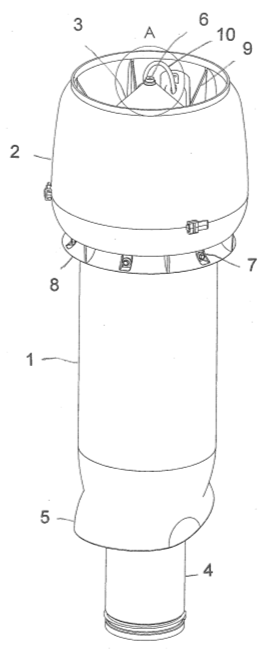
The decision concerns a revocation action brought by WIRPLAST against EP2649380, owned by VILPE, relating to an exhaust ventilation pipe extending through a building roof, provided with a hat and a conical cup. The characterising feature was the integration of a circular spirit level on top of the conical cup, allowing installers to immediately verify correct vertical alignment during installation, particularly on inclined roofs.
Revocation was sought solely on the ground of lack of inventive step. The central question was whether the claimed invention was obvious starting from D1 (DE 10118226 C1), a prior art document disclosing a roof‑mounted ventilation fan.
Closest prior art and realistic starting point
The court accepted that D1 was a realistic starting point within the meaning of UPC case law. D1 belongs to the general field of ventilation devices and shares several structural elements with the claimed invention, including a housing with a conical upper cover intended to prevent ingress of rain.
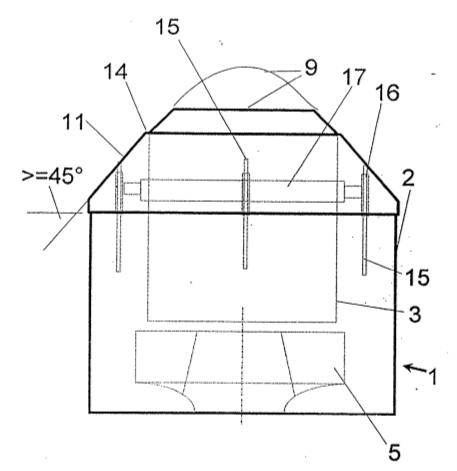
However, even though D1 was accepted as a starting point, the court considered it highly significant that D1 discloses a different kind of device and addresses a different technical problem. In particular, the device of D1 is a roof fan mounted by a base plate in abutment to the roof surface, rather than a pipe that passes through the roof. The problem addressed by D1 is improving rain, snow and wind resistance via a flow‑actuated closure, not facilitating vertical installation.
These differences were not treated as superficial. The court had earlier construed the “extending through the roof” feature as a limiting physical and spatial feature, not merely a statement of suitability. As a result, the skilled person would understand the claimed invention and the roof fan of D1 as fundamentally different installation concepts.
Crucially, because the angular orientation of the roof fan in D1 is determined by the roof itself, the skilled person would have no motivation to consider the problem of vertical alignment at all, still less to integrate a circular spirit level.
Objective technical problem
Applying the UPC’s structured approach to inventive step, the court identified the objective problem as:
Providing an exhaust ventilation pipe extending through the roof of a building that is configured for easy and fast vertical installation.
This formulation was tightly linked to the claimed device’s physical and spatial configuration, in particular the fact that the pipe extends through the roof, with parts of the device both below and above the roof surface.
No motivation to modify D1
The court rejected the claimant’s argument that adding a spirit level was an obvious workshop modification. While circular spirit levels were common general knowledge, there was no evidence that integrating them into roof‑mounted ventilation devices was routine. Furthermore, modifying D1 to include an exhaust pipe extending through the roof (feature F4) was itself unexplained and unsubstantiated.
The court emphasised the UPC standard that the skilled person must “would”, not merely “could”, arrive at the claimed solution.
Accordingly, the claimed modification would require inventive skill, not routine design choice.
Combination attacks
The same reasoning undermined all combination attacks (D1 with common general knowledge or with D2–D4). Each secondary document related to yet another type of device (air conditioner, passive roof convector, static ventilator), addressing different objectives and installation contexts. None supplied a credible pointer towards adapting D1’s roof fan into a through‑roof exhaust pipe or integrating a spirit level at the claimed location.