National offices report increases in national patent applications throughout Europe: Is the EPO no longer “killing” the national offices?
The Swedish National Patent Office (PRV) recently reported a 13 per cent year‑on‑year increase in national patent applications in 2025. A review of available data from across the EPO area suggests that this is not an isolated development. On the contrary, a similar trend appears to be emerging across much of Europe. In this article, we take a closer look at the numbers and consider what may bedriving this shift.
The numbers
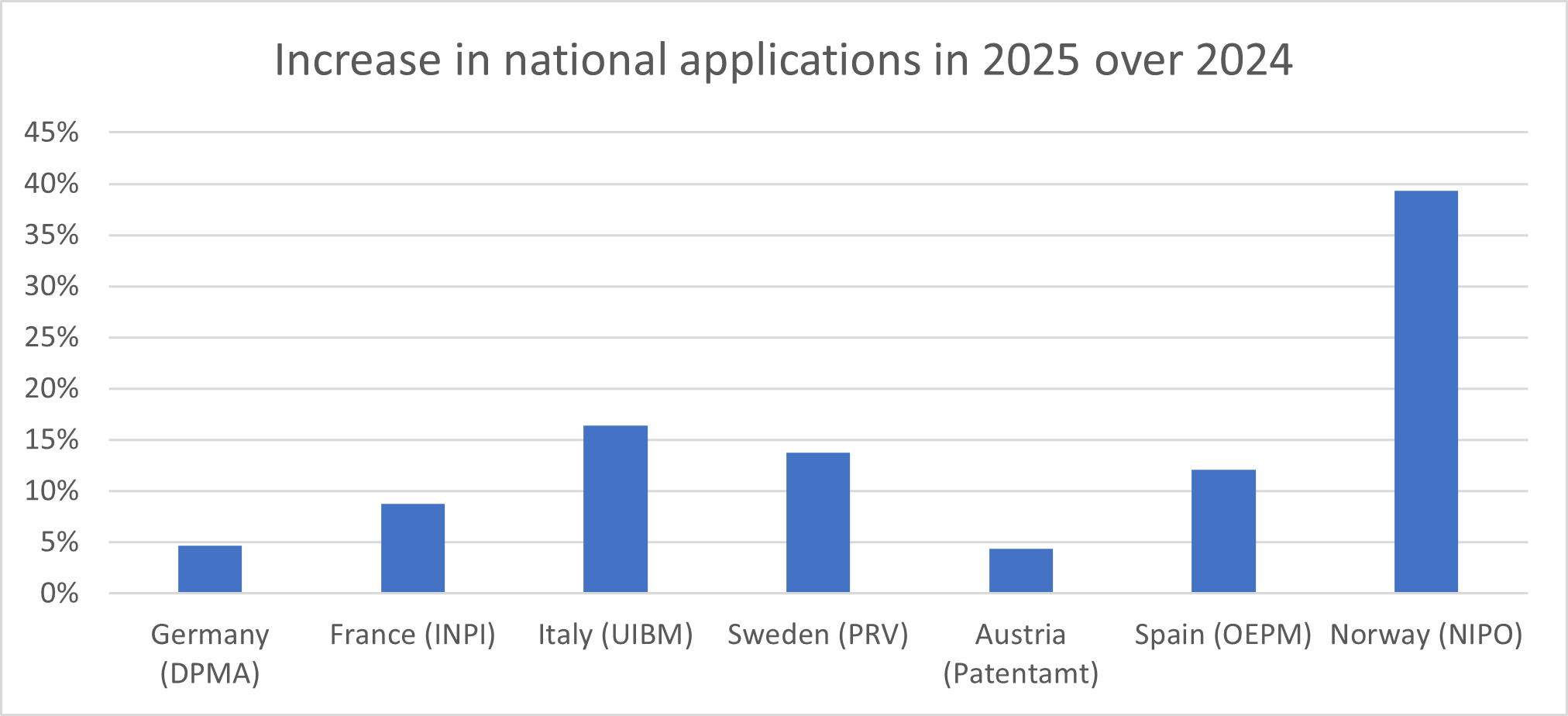
Let us start with the data. As of writing, figures for national patent applications in 2025 are available for Germany [1], France [2], Italy [3], Sweden [4], Austria [5], Spain [6] and Norway [7] [8]. All of these national offices reported an increase in filings, ranging from approximately 4 per cent at the Austrian Patent Office to almost 40 per cent at the Norwegian NIPO.
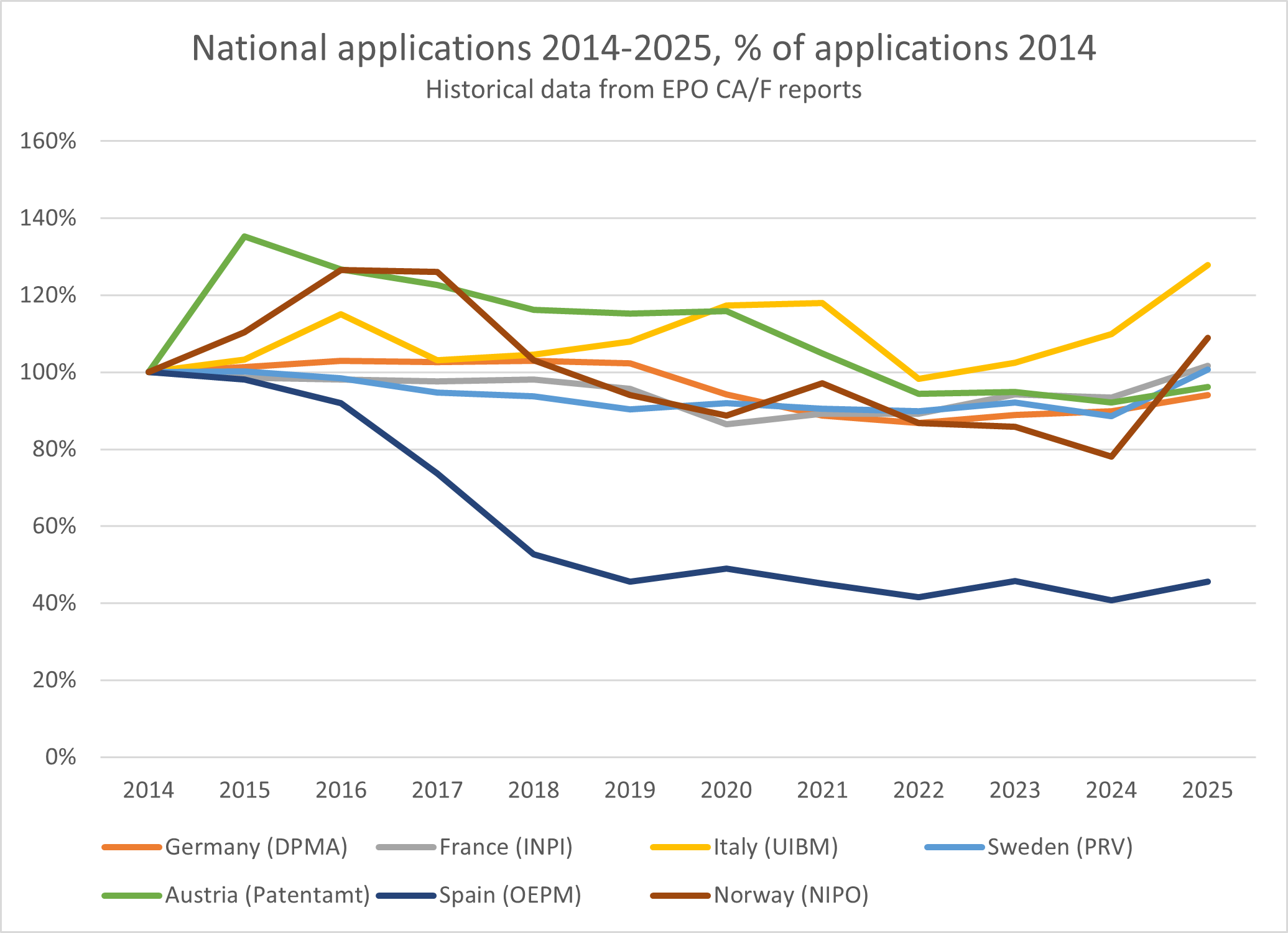
This marks a clear departure from the long‑term trend. Historically, national patent filings in Europe have shown a slow but steady decline. The graph below illustrates the number of patent applications, both first filings and PCT national phase entries, normalised against each country’s 2014 filing level.
For context, in 2014 the number of applications was 65,963 in Germany, 16,533 in France, 9,385 in Italy, 2,425 in Sweden, 2,363 in Austria, 3,178 in Spain and 1,627 in Norway. From 2014 onwards, most offices experienced a gradual decrease. While some saw early signs of recovery in 2023, 2025 stands out as the first year in which all of the reviewed offices show a clear increase.
Why now?
It is still too early to determine whether this development represents a lasting shift. More data over coming years will be needed to assess its statistical significance. Nevertheless, the fact that the increase appears across multiple jurisdictions suggests that common, Europe‑wide factors may be at play.
The German Patent and Trade Mark Office (DPMA), for example, notes strong growth in filings relating to computer technology and digital communications, which are fields characterised by extensive use of machine intelligence [2]. The DPMA also reports an increase in applications relating to electrical drives, a core technology underpinning electrification in transport, industry and power generation. This may be an early signal that the green transition is translating into increased patenting activity.
In Italy and Austria, the respective patent offices highlight another driver: universities have become increasingly active filers [3] [5]. The incentives for academic researchers to protect intellectual property appear to be strengthening. In Italy, this trend may in part be linked to the abolition of the professor’s privilege in 2023, a reform that shifted ownership of employee inventions to universities and paved the way for more institutional filings [3].
PRV, meanwhile, points to the continued popularity of the EUIPO patent fund for small and medium‑sized enterprises, which has now been running for five consecutive years and provides financial support for IP protection [4].
The rise of self‑drafting and AI
Both PRV and the Norwegian NIPO also report a notable increase in individual inventors filing without professional representation. According to PRV, the number of applicants without representatives doubled in 2025 [4]. NIPO similarly observes a large number of applications that appear to have been drafted using AI tools [7].
From an inventor’s perspective, the appeal is obvious. Compared with the cost of professional representation, access to an AI chatbot is inexpensive, and national filing fees are often relatively low. In many cases, this reduces the upfront cost of seeking patent protection from several thousand euros to just a few hundred. Viewed in this light, the trend may be seen as a form of democratisation of the patent system.
There is, however, a less optimistic side. National offices report that AI‑drafted applications often lack clarity and contain formal deficiencies. Once substantive examination begins, such shortcomings can be difficult to remedy without professional assistance. Moreover, while AI tools may lower the entry barrier, they do not necessarily make the patent system more transparent for inventors, who may struggle to prompt these tools to address examiner objections effectively.
The growing use of AI as an ideation tool raises additional questions. Many jurisdictions have made it clear, for example in the DABUS cases, that artificial intelligence cannot itself be an inventor. At the same time, concerns remain around training data and its implications for novelty and inventive step, particularly where models are trained on data of uncertain provenance.
Conclusion
The recent increase in national patent filings points towards several positive developments across Europe. SMEs appear more engaged in protecting their innovations, activity in green and machine‑intelligence‑related technologies is rising, and access to the patent system may be broadening.
At the same time, the growth in AI‑assisted self‑drafting may increase the workload of national offices without necessarily leading to a corresponding rise in granted patents. In the longer term, this raises an interesting question: will the role of national patent offices evolve further, placing greater emphasis on education and guidance for individual inventors?
References
[1] DPMA, “Aktuelle Statistiken: Patente,” 24 February 2026. [Online]. Available: https://www.dpma.de/dpma/veroeffentlichungen/statistiken/patente/index.html. [Accessed 23 March 2026].
[2] INPI, “INPI Key Figures 2025,” 03 February 2026. [Online]. Available: https://www.inpi.fr/en/a-la-une/chiffres-cles-inpi-2025. [Accessed 23 March 2026].
[3] UIBM, “Mimit: Report Brevetti +18,2% nel 2025,” 02 March 2026. [Online]. Available: https://www.mimit.gov.it/it/notizie-stampa/mimit-report-brevetti-18-2-nel-2025. [Accessed 23 March 2026].
[4] PRV, “Trendbrott i antal ansökningar till PRV,” 12 March 2026. [Online]. Available: https://www.prv.se/sv/om-oss/nyheter/okning-av-antalet-ansokningar-till-prv/. [Accessed 23 March 2026].
[5] Österreichisches Patentamt, “Österreich erfindet wieder deutlich mehr: Patentamt verzeichnet Anstieg bei Anmeldungen,” 05 March 2026. [Online]. Available: https://www.ots.at/presseaussendung/OTS_20260305_OTS0042/oesterreich-erfindet-wieder-deutlich-mehr-patentamt-verzeichnet-anstieg-bei-anmeldungen. [Accessed 23 March 2026].
[6] Elzaburu, “Récord de solicitudes en 2025: las cifras clave de Propiedad Industrial en España,” 03 March 2026. [Online]. Available: https://elzaburu.com/record-solicitudes-propiedad-industrial-2025-oepm/. [Accessed 23 March 2026].
[7] Patentstyret, “Økning i norske patentsøknader,” 25 February 2026. [Online]. Available: https://kommunikasjon.ntb.no/pressemelding/18812322/okning-i-norske-patentsoknader?publisherId=4739852&lang=no. [Accessed 23 March 2026].
The Latest Thought Leadership pieces in the Content Hub

The Patent Strategist
Get expert insights and the top patent stories delivered straight to your inbox.