Court of Appeal gives Babek’s trade mark a gold star for validity

The Court of Appeal has handed down its judgment in the case of Babek International Ltd v Iceland Foods Ltd, dismissing Iceland’s appeal against His Honour Judge Hacon’s decision. The first instance judgment dismissed Iceland’s application for summary judgment in its counterclaim for a declaration that Babek’s trade mark was invalidly registered. The parties agreed that Hacon J should also determine the validity of the trade mark which was held to be valid at first instance. The appeal was heard by Lord Justice Newey, Lord Justice Arnold and Lord Justice Zacaroli.
Key points:
- To be registered as a trade mark a sign must be capable of graphical representation and distinguishing the goods or services of one undertaking from those of other undertakings. These are independent and cumulative conditions.
- A trade mark should not include variations where it would be possible for another sign to be identical to some of the variations but not others.
- The categorisation of a trade mark, the pictorial representation and the written description will all be equal factors in interpreting the mark.
- An applicant providing a description when filing can use a summary rather than attempting to describe every feature of the mark.
Background of the case
The relevant trade mark was originally filed in the EU and replaced by a comparable UK trade mark following Brexit. While the EU application described the mark as figurative, this categorisation was not included on the UK Register. The UK trade mark registration is described as “Gold oval with embossed BABEK writing. Colour Claimed: Gold, black.” and includes the following pictorial representation:
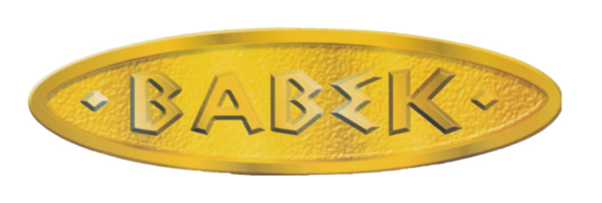
At the trial, Iceland submitted that the trade mark was invalid due to a lack of clarity and precision at the date of registration. In his first instance judgment, Hacon J commented that arriving at the conclusion that the verbal representation was inconsistent with the written description would require pedantry which would render the trade mark system unworkable. He held that the trade mark was valid as it satisfied the requirements of section 1(1) of the Trade Marks Act 1994 and was not in breach of section 3 (absolute grounds for refusal).
The appeal
The Court of Appeal noted that under assimilated EU law, there are three conditions which must be complied with when registering a trade mark in order to satisfy Article 2 of Directive 2008/95/EC, Article 4 of Regulation 40/94/EC and section 1(1) of the Trade Marks Act 1994:
- The mark must be a sign;
- The sign must be capable of being represented graphically in a way which is clear, precise, self-contained, easily accessible, intelligible, durable and objective; and
- The sign must be capable of distinguishing the goods or services of one undertaking from those of other undertakings.
Iceland argued that the trade mark failed to satisfy the first and second conditions. The Court of Appeal noted that it did not appear that the parties had distinguished between the first and second conditions in their arguments at trial but suggested it is better for them to be considered separately.
Further, it was clear from the authorities that a written description which embraces a multiplicity of signs does not comply with the first condition. Babek argued that a single sign whose appearance may vary within permissible limits could be validly registered which would be assessed as a question of fact and degree. Iceland asserted that no variation would be permissible but, in the alternative, if variation was permissible then the test would be whether the differences between variations would be noticed by the consumer. The Court of Appeal considered it unnecessary to resolve this point in the present case as it was decided that the trade mark did not include variations.
The second condition dictates that a sign must be capable of graphical representation. The Court agreed that for the trade mark system to operate it must be possible to compare earlier and later trade marks as well as to compare a trade mark with an allegedly infringing sign. Consequently, it is not possible for trade marks to comprise variations where only some would be assessed as identical to the other relevant trade mark or sign.
Grounds of appeal and outcome
Iceland appealed on six grounds. On the first ground, the Court held that Hacon J’s reliance on the “capacity to distinguish” test was legally erroneous as the three conditions which must be considered are independent and cumulative. The correct approach is to determine first whether there is a sign and whether it is clearly and precisely represented, before considering whether it has a capacity to distinguish. The fact that the wrong test had been applied at trial meant that it was down to the Court of Appeal to reconsider the issues. The second ground then fell away as it was based on the assumption that the “capacity to distinguish” test was the correct approach.
It was common ground between the parties that the court should take into account the categorisation of the trade mark as a figurative mark, the pictorial representation and the accompanying written description which would all be equal factors in interpreting the trade mark. Iceland argued that Hacon J erroneously considered the categorisation as a “fixed starting point” and the pictorial representation as taking precedence over the written description. This formed grounds three and four of the appeal, but the argument was ultimately rejected by the appeal judges.
On ground five, it was held that Hacon J should not have referred to “state of the register” evidence as it was irrelevant and therefore inadmissible. The Court of Appeal determined that referring to the relevant registrations had formed part of Hacon J’s erroneous “capacity to distinguish” test. Iceland also presented arguments on Hacon J’s comments about the colours of the mark under ground six of the appeal, but this was considered to be “nit-picking” by Lord Justice Arnold.
When reconsidering the issues before Hacon J, the Court of Appeal held that the categorisation of the trade mark as figurative was a useful starting point which was not inconsistent with the pictorial representation and the written description in this case. Hacon J’s interpretation of “embossed” as being understood as referring to the shadowing effect in the image was upheld, as was his view that “gold oval” and “gold and black” described the pictorial representation. Lord Justice Zacaroli added that the alternative interpretation presented by Iceland that the written description was included to describe a range of possible signs would not be tenable. A reasonable reader would appreciate that an applicant completing a description of the pictorial representation would likely provide this as a summary rather than attempting to provide an exhaustive list of the features. This meant that the trade mark complied with the condition that it must be a single sign.
The Court of Appeal disagreed with Hacon J’s statement that the pictorial representation is subject to minor variations in hue. Babek were unable to pick out anything in the written description which included variations, but this would not prevent them from enforcing their trade mark against the use of similar signs. On this basis, it was held that the trade mark also complies with the condition that a trade mark must be clear and precise.
The Court of Appeal dismissed the appeal and affirmed that the trade mark is valid.
The judgment is available here.