Chinese Companies in European Patent Litigation (Part 2)

Part 2 | Where German national courts can addvalue alongside the UPC
The Unified Patent Court (UPC) dominates the conversation about European patent enforcement, but the German national courts are still here, and for many disputes they remain an option worth considering alongside it. This second article in our series on Chinese companies in European patent litigation explains when a German national court deserves a place in the forum analysis for Chinese patent owners.
Everybody is talking about the UPC. Since it opened on 1 June 2023, it has attracted a steady stream of high-profile disputes and, as Part 1 of this series showed, Chinese parties are involved in a large share of them: in 2025, 97 of 253 visible infringement actions, or about 38%, involved at least one Chinese party.[1] In 2026 so far (as of 11 November 2026), our analysis shows that 64 of 210 new infringement actions and applications for provisional measures, or about 31%, involve a Chinese party.[2] But the national courts continue to exist, and in Germany – the traditionally most frequent forum for patent infringement proceedings – they are anything but quiet. The latest 2025 data shows that the seven German courts with patent chambers received 627 new patent and utility model actions, almost 14% more than in 2024 and the first annual increase since 2021. Munich Regional Court alone recorded an all-time high of 332 new actions, 43.7% more than the year before.[3] Below, we set out where German national courts may beat the UPC on speed, cost and validity risk, and where they cannot.
The transitional period keeps the choice open
The UPC’s transitional regime is what allows the two systems to run in parallel. For seven years from 1 June 2023, that is until 31 May 2030, national courts and the UPC share jurisdiction over “classic” European patents, meaning European patents without unitary effect. The period may be prolonged by up to seven further years.[4] Within the transitional period, a patent owner can choose between the UPC and the national courts unless the patent has been opted out. An opt-out keeps the patent with the national courts, but it is not necessarily final. The proprietor may withdraw it at any time, unless an action concerning the patent has already been brought before a national court[5], including separate validity proceedings. According to the UPC Court of Appeal, national proceedings that were already pending before the UPC opened do not prevent a withdrawal.[6][7]
The choice between the UPC and the national courts therefore exists for the overwhelming majority of European patents (subject to a withdrawable opt-out). Which forum is preferable depends on the case, because speed, costs, validity risk and territorial reach can each point in a different direction.
Where the UPC has the edge
The UPC’s principal advantage is reach. A single action can lead to an injunction across all participating states in which the patent has effect, currently eighteen, and the prospect of a multi-country injunction creates settlement leverage that no national court can match. Infringement and validity are heard together, English is now the most frequently used language of proceedings, and in suitable cases the Court can extend its reach beyond UPC territory through long-arm jurisdiction (though this applies also to national courts), although its limits are still being clarified.[8][9] For a Chinese patentee whose competitor sells the same product across Europe through pan-European distribution or fulfilment structures, this can be decisive.
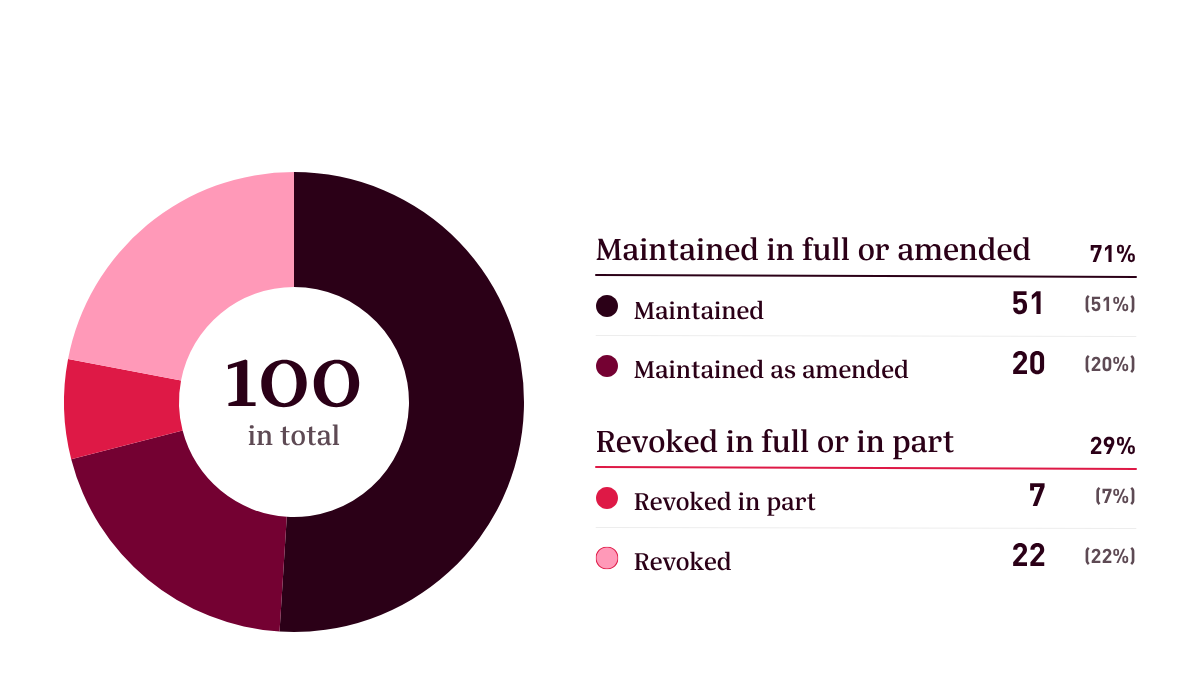
The downside of this reach is that the invalidation risk is concentrated in a single proceeding. A counterclaim for revocation puts the patent in jeopardy in all UPC states at once. In EIP’s analysis of first-instance decisions on counterclaims for revocation (as of 11 November 2026), around 71% of the challenged patents survived, either as granted or in amended form, but about 22% were revoked in full and a further 7% in part.[10] A patent owner who is confident on infringement but less certain on validity may therefore prefer a forum in which a defeat on validity is contained.
What German national courts can offer alongside the UPC
Germany may be the market that matters. Where the accused product is sold mainly or critically in Germany, a German injunction may already be sufficient. In that case, the UPC’s broader territorial reach may add comparatively little, while a revocation counterclaim would put the patent at risk across all UPC states. A German court can also be an option for early action against a competitor, for example when it presents an allegedly infringing product at a trade fair in Germany. We will look at the “trade fair scenario” in more detail in a follow-up article.
Speed. The UPC aims for a first-instance decision within 12 to 14 months, but our data shows a median of about 15.6 months for merits decisions in infringement actions with a revocation counterclaim, with the busiest German Local Divisions (Düsseldorf, Munich and Mannheim) above that.
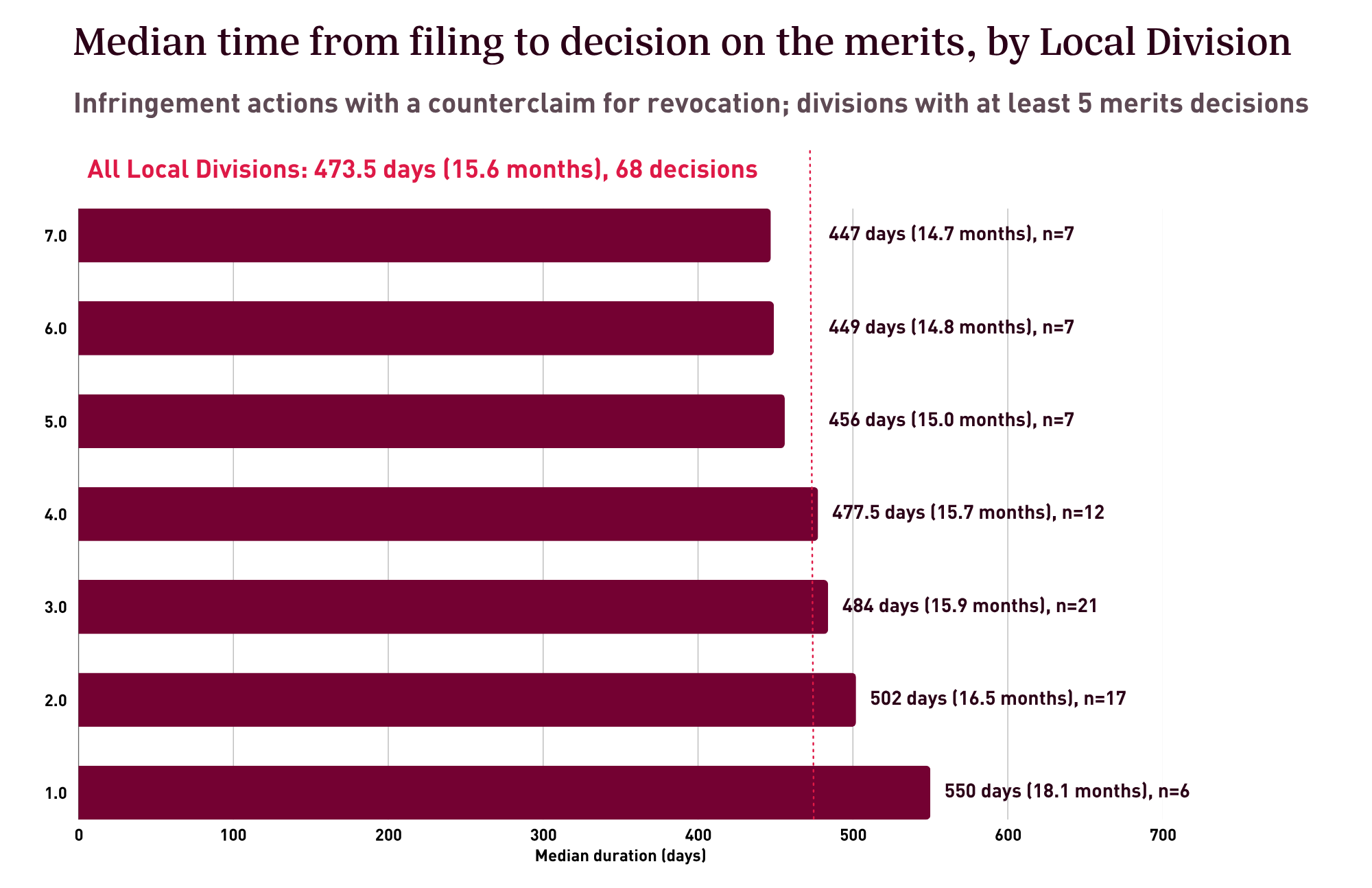
German national courts may in some cases be faster. Hearings typically take place around 12 to 14 months from filing, and can be scheduled earlier depending on the venue; the often-favoured Munich Regional Court has recently held hearings 10 to 12 months from filing, with judgment following some weeks later. Depending on the venue, a German court can therefore be as fast as or faster than the UPC, particularly the busy German Local Divisions, although that may change as UPC cases spread more evenly across divisions.
Costs and reimbursable attorney fees. Both systems apply the loser-pays principle and tie recoverable costs to the value in dispute, but the exposure differs. Values in dispute tend to be higher at the UPC, depending on the case and, for example, on how many member states the enforcement covers. Assuming the same value in dispute of €1.5 million for the sake of comparison, court fees are similar in both forums at about €25,000, but recoverable attorney costs for infringement proceedings are about €22,000 in Germany and up to €200,000 at the UPC. Chinese claimants may also face security for costs. In Germany this is more likely, as it is tied in principle to a seat outside the EU/EEA, but it is limited to statutory recoverable costs. The UPC decides case by case, based on the claimant’s financial situation and the enforceability of a costs order, and the security can reach the much higher cost ceiling (up to €200,000 at this value).[11] In Germany, a successful patentee must also budget for liquidity: a first-instance injunction can usually be enforced only against security (by default set at the same amount as the value in dispute) to cover any damage the defendant may suffer if the judgment is later overturned, typically a bank guarantee or cash deposit.
Bifurcation and the injunction gap. In Germany, the Regional Court decides infringement, while validity is tested separately before the Federal Patent Court and at the European Patent Office (EPO). Because the infringement court may grant an injunction before validity has been decided, a patentee can in some cases obtain relief during the so-called “injunction gap”. The legislator has tried to narrow this gap by now expecting the Federal Patent Court to issue a preliminary opinion on validity within six months of service of the nullity action.[12] The infringement court typically “follows” this preliminary opinion – if it is negative for the patentee, the court will usually stay the infringement proceedings pending the Federal Patent Court's decision in the nullity action; if it is positive, it will be difficult for the defendant to convince the court of a stay. However, this deadline, which usually expires before the oral hearing, is not always met. More recently, we have increasingly seen cases in which no preliminary opinion on validity was available before the oral hearing or even before the first-instance judgment, which sometimes brings the injunction gap back. This may be linked to a growing backlog at the Federal Patent Court. For a patentee with a strong infringement case and manageable validity risk, this structure can be attractive, but it cuts both ways: an injunction may be granted before validity is decided, and a patentee that enforces it bears the risk of liability if the judgment is later overturned. For a patentee with a more vulnerable patent, the structure avoids the risk of revocation in all UPC states in a single proceeding, although an EPO opposition, while still available, can have a similar effect across all designated states.
Utility models. The UPC has no jurisdiction over German utility models, but they can be a powerful complement to a European patent family. A utility model can be branched off from a pending European, PCT or German application covering Germany, keeps the parent’s filing and priority date, is registered within weeks without substantive examination and can be drafted with the accused product in mind. The trade-offs include the lack of a presumption of validity, a maximum term of ten years from the parent’s filing date, the exclusion of method claims and protection in Germany only. Chinese applicants have taken note: they filed 35.9% more utility model applications at the German Patent and Trade Mark Office in 2025.[13] The dispute between Yangtze Memory Technologies (YMTC) and Micron shows the approach in action. On 18 September 2026, the Munich Regional Court granted YMTC two first-instance injunctions based on German utility models, while YMTC asserts three European patents against Micron before the UPC’s Düsseldorf Local Division.[14][15]
SEPs. For standard-essential patents (SEPs), the approach of the (German) Local Divisions is close to that of the German courts, although the UPC Court of Appeal has not yet given guidance on FRAND. Both apply a conduct-based assessment under the CJEU’s Huawei v ZTE decision, and both have so far rejected implementers’ FRAND defences (note though that on 6 November 2026 the Milan Local Division upheld a FRAND defence for the first time, [16]).
More recently UPC judges have indicated that they would consider conducting a FRAND rate determination, which, for legal framework reasons, German courts are not expected to carry out.[17] A SEP owner that wants injunction leverage without inviting a court-led rate determination may therefore prefer the German route, while one that would welcome such a determination may look to the UPC.
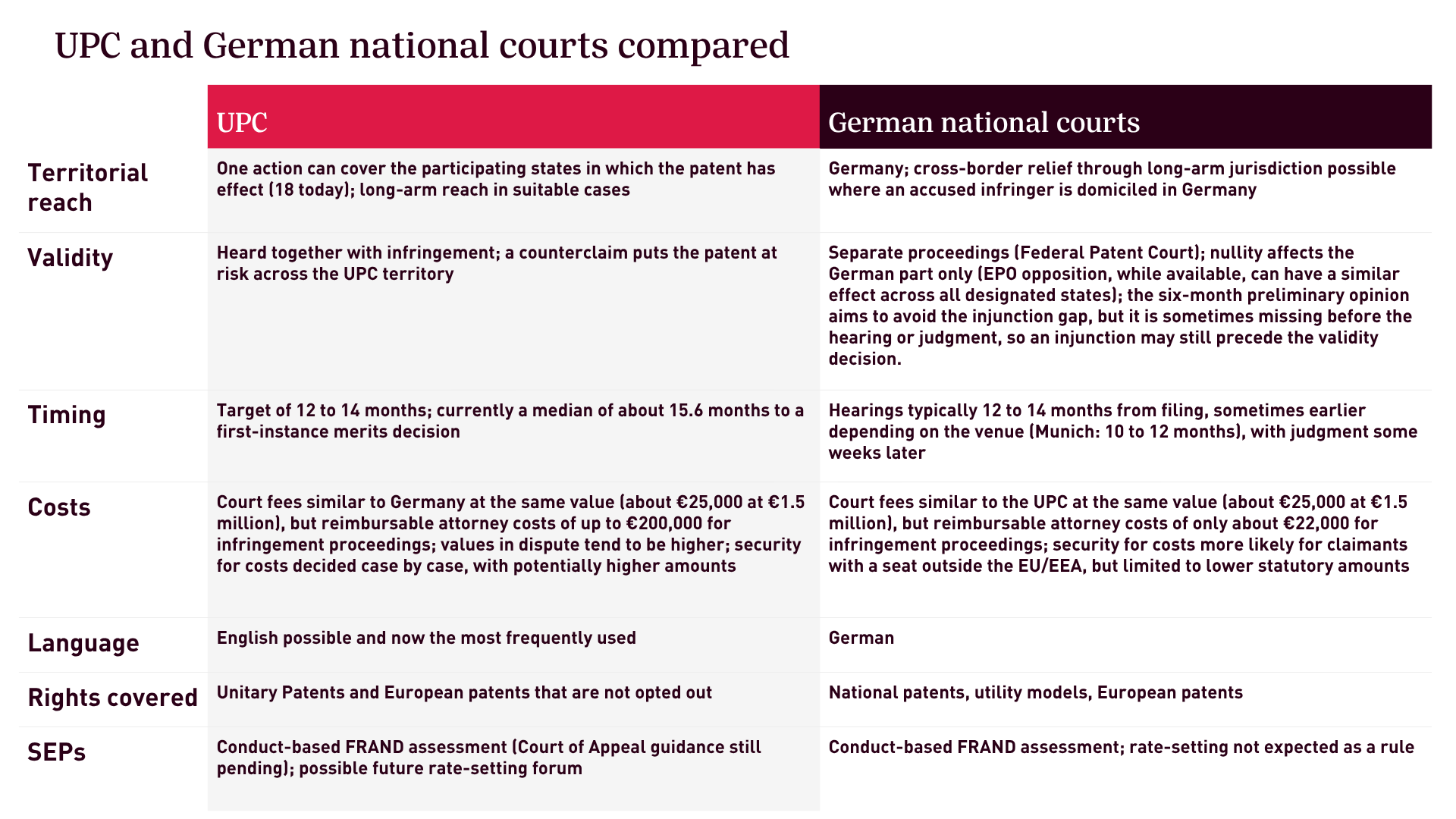
The two forums at a glance
A practical approach to forum choice
From a practical perspective, the question is not whether the UPC or a German court is “better”, but which forum fits the individual dispute. For a strong patent that is infringed across several UPC states, the UPC may justify its broader exposure. Where Germany is the key market, where speed, cost predictability or a limited territorial focus matter, or where the validity risk for the wider patent family should be contained, a German national action is worth including in the analysis. A mixed approach is often the most effective: a German action, or a German utility model, to create fast leverage in the key market, combined with UPC proceedings on other patents or territories, as the YMTC dispute illustrates. Forum strategy should be decided early and patent family by patent family, because factors such as opt-out status, the timing of a utility model branch-off and the choice of parties to sue cannot always be changed once proceedings are under way.
Key takeaways
• National courts remain available at least until 31 May 2030, the end of the seven-year transitional period, and opted-out European patents stay with the national courts unless the opt-out is withdrawn, which is possible only as long as no national action has been brought.
• Consider the UPC where the patent is strong, the products are sold across several UPC states and broad settlement leverage is the objective.
• Also consider a German national court where Germany is the main pressure point, where speed or cost predictability matter, where the risk of revocation across all UPC states should be contained (EPO opposition aside) or where a utility model can be used, bearing in mind the separate validity proceedings.
• Budget for security for costs and, in Germany, for enforcement security, and plan for German-language proceedings and translations.
• Decide forum strategy early and per patent family, and coordinate it with EPO oppositions, opt-outs and licensing discussions.
Up next: In the next article in this series, we look at how service of process in China and security for costs can shape the timing and economics of European patent disputes.
Sources
[1] EIP, “Chinese companies and the UPC: from enforcement targets to strategic users”, 13 August 2026, https://eip.com/uk/thought-leadership/chinese-companies-and-the-upc-from-enforcement-targets-to-strategic-users.
[2] EIP analysis of UPC infringement actions and applications for provisional measures filed in 2026 (210 cases), as of 11 November 2026.
[3] JUVE Patent, “Munich drives rising case numbers in Germany”, 18 February 2026, https://www.juve-patent.com/people-and-business/munich-drives-rising-case-numbers-in-germany/.
[4] cf. Article 83(1) and (5) of the UPC Agreement.
[5] Unified Patent Court, “Frequently Asked Questions: Opt-out”, https://www.unifiedpatentcourt.org/en/faq/opt-out.
[6] UPC Court of Appeal, AIM Sport v Supponor, UPC_CoA_489/2023 and UPC_CoA_500/2023, decision of 12 November 2024 (withdrawal of an opt-out is not precluded by national proceedings pending before 1 June 2023).
[7] EIP, “UPC Court of Appeal Overturns Helsinki on Opt Out Withdrawal” (AIM Sport v Supponor, UPC_CoA_489/2023 and UPC_CoA_500/2023, decision of 12 November 2024), 14 January 2025, https://www.eip.com/uk/case-reports/upc-court-of-appeal-overturns-helsinki-on-opt-out-withdrawal.
[8] CJEU, 25 February 2025, C-339/22, BSH Hausgeräte v Electrolux.
[9] UPC Court of Appeal, UPC_CoA_789/2025 and UPC_CoA_813/2025, 6 March 2026, referral for a preliminary ruling by the Court of Justice of the European Union (Dyson v Dreame).
[10] EIP analysis of UPC first-instance decisions on counterclaims for revocation (100 decisions), as of 11 November 2026.
[11] UPC Court of Appeal, Audi AG v Network System Technologies LLC, UPC_CoA_217/2024, UPC_CoA_219/2024 and UPC_CoA_221/2024, order of 17 September 2024 (security for costs depends on whether the claimant’s financial position gives rise to a legitimate and real concern that a costs order may not be recoverable or may be enforceable only in an unduly burdensome way).
[12] Section 83(1) of the German Patent Act [PatG].
[13] German Patent and Trade Mark Office (DPMA), Annual Report 2025 (utility models), https://www.dpma.de/digitaler_jahresbericht/2025/jb25_en/utility-models.html.
[14] JUVE Patent, “YMTC wins first round in Micron case over NAND technology”, 24 September 2026, https://www.juve-patent.com/cases/ymtc-wins-first-round-in-micron-case-over-nand-technology/.
[15] ip fray, “YMTC wins two German injunctions against Micron, getting leverage in global NAND memory patent fight”, 18 September 2026, https://ipfray.com/ymtc-wins-two-german-injunctions-against-micron-getting-leverage-in-global-nand-memory-patent-fight-munich-i-regional-court/.
[16] In its decision Ericsson v ASUS of 6 November 2026, UPC_CFI_318/2024 (counterclaim UPC_CFI_730/2024), the Milan Local Division upheld a FRAND defence. As Ericsson – according to the Local Division – had not given ASUS a concrete infringement notice before filing suit, the court refused an injunction, among other remedies. The court did not accept that this deficiency could be cured during infringement proceedings in which an injunction had been sought.
[17] A notable exception is the ZTE v Samsung judgment of the Munich Regional Court’s 7th Civil Chamber (Presiding Judge Dr Schön), which calculated a FRAND rate on a hypothetical basis in an obiter dictum. That was, however, a highly unusual case with two parallel rate-setting proceedings in the UK and China (Chongqing Intermediate People’s Court), cf. Munich I Regional Court, 7th Civil Chamber, 7 O 64/25, judgment of 30 April 2026 (GRUR-RS 2026, 8886).
The Latest Thought Leadership pieces in the Content Hub
Chinese companies in European patent litigation

The Patent Strategist
Get expert insights and the top patent stories delivered straight to your inbox.