UPC Infringement Actions: Is Speed Meeting Expectations?

The Expected Timeline
The preamble to the Rules of Procedure sets out the lofty aim that "proceedings shall be conducted in a way which will normally allow the final oral hearing on the issues of infringement and validity at first instance to take place within one year" [1]. This target appeared achievable based on the Rules of Procedure themselves, which set out time limits imposed on the parties at many of the stages of an action as well as some aims for when the court itself will take certain steps. Based on these parts of the Rules, we estimated that infringement proceedings would be dealt with in 10.5 - 13.5 months from service of the statement of claim, as shown in the expected timeline below. The length of the written procedure was expected to be shortest for infringement actions with no counterclaim for revocation and longest for those with a counterclaim and an application to amend.
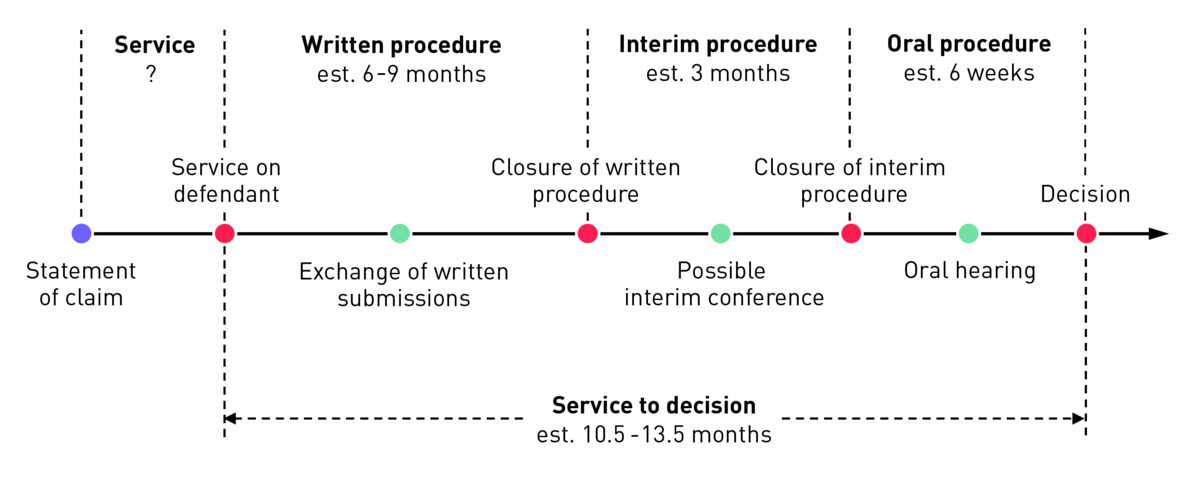
Service to Oral Hearing
Given that the preamble to the Rules of Procedure explicitly sets out the goal of having the final hearing take place within twelve months, this seems like a good place to start looking at how well the UPC is sticking to its promise of fast and efficient proceedings.
The UPC missed the 12-month target in 50% of cases, but it is close: 50% of cases were decided within 12 months and 5 days measured from service of the statement of claim [2].
The chart and table below show the time from service of the statement of claim to the final hearing for all of the 43 infringement actions decided up to 1 September 2025:
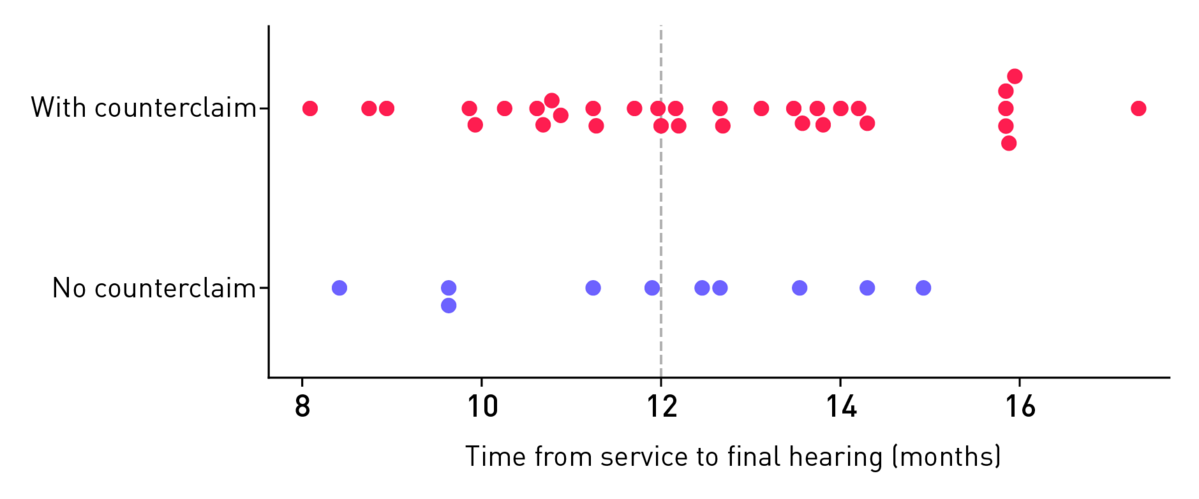
Bearing in mind that this is a new court finding its feet, with many unclear procedural provisions requiring input from the Court of Appeal, it is promising that in 75% of cases the oral hearing was held within 14 months from service of the statement of claim.
Oral Hearing to Decision
Looking only at the time from service to the final hearing gives an incomplete picture. What really matters to claimants (and defendants) is the time required to reach the decision. A long delay in reaching a decision after the final hearing would undermine the effort required from both the UPC and the parties to get to the final hearing in roughly a year.
According to the Rules of Procedure, the court "shall give the decision on the merits as soon as possible after the closure of the oral hearing" and "shall endeavour to issue the decision on the merits in writing within six weeks of the oral hearing" [3].
So far, the UPC has managed to hit this six-week target in only 40% of cases, as illustrated by the chart and table below:
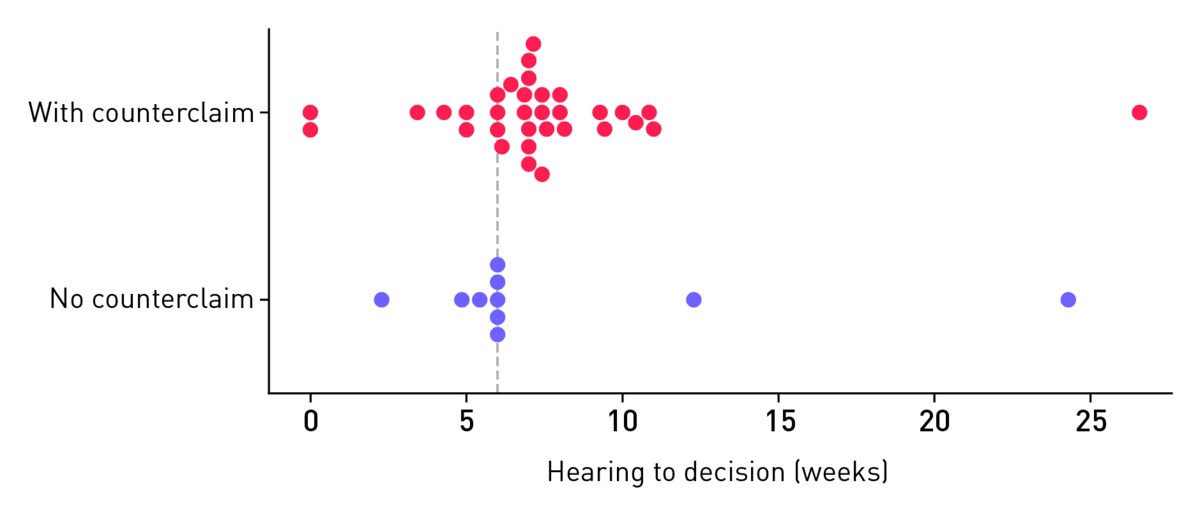
However, the delay is not severe, with 75% of decisions issued within 8 weeks of the hearing, and the cluster of decisions issued exactly 6 weeks from the hearing, visible as the points falling on the dashed line in the chart above, indicate that the UPC is generally trying to meet this target.
Furthermore, the extreme outliers at close to six months from the hearing to the decision result form the unique circumstances of the cases in question. For example, in one of the outliers[4], oral proceedings were held in a co-pending EPO opposition the day after the final hearing at the UPC, and the court delayed its decision in order to take into account developments in the EPO case.
Total Time From Service to Decision
Putting these two time periods together, the total time from service to decision across the 43 decided infringement actions breaks down as follows:
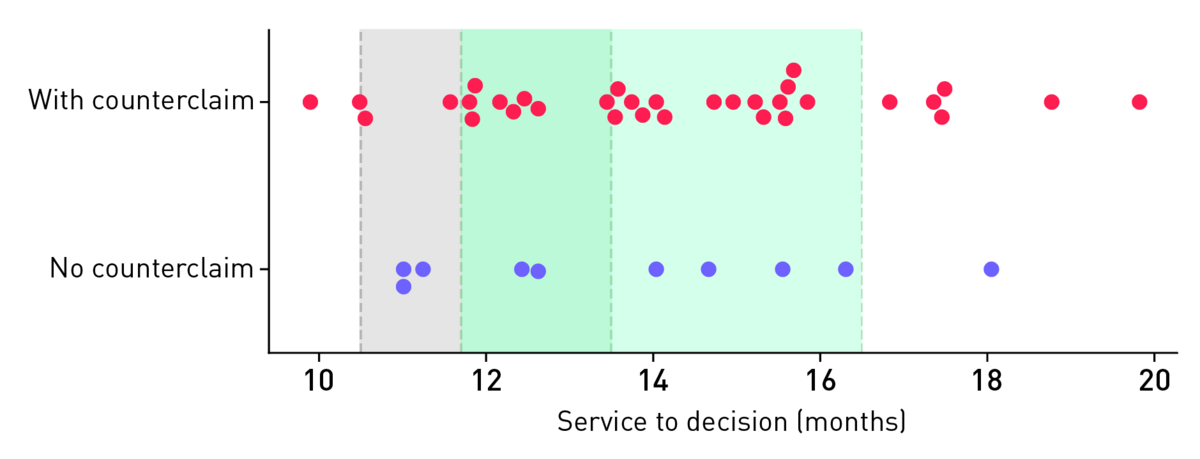
Despite not straying too far from the individual 12-month and 6-week targets discussed above, the chart above clearly shows that the original estimate of 10.5 to 13.5 months (shown with grey-shaded area of the chart above) was overly optimistic. The clear majority of cases fall outside this time range, with only one outlier falling below the lower bound. Based on the available data, it would be more accurate to state that the typical range is 11.7 to 16.5 months[5] (shown in the green-shaded area of the chart above).
Incorrect Assumptions?
The longer-than-expected timeline for service to final decision raises the question: where are the assumptions made in the preparation of the original estimate holding up, and where are they being proven wrong?
It helps to first separately consider the cases in which a counterclaim for revocation was filed and those where a counterclaim was not filed .
The mean length from service to decision for actions without a counterclaim is around 3 months longer than expected at 13.7 months compared to the estimated 10.5 months. For actions with a counterclaim, the difference between the mean and the expected duration is less than 1 month.
While the mean time from hearing to decision is slightly longer for actions with no counterclaim than those with a counterclaim, it is clear from the chart above that the time from hearing to decision is, in general, shorter for actions with no counterclaim, with 80% hitting the 6-week target. This is understandable, since it's much easier to decide and ultimately write a decision only on infringement than on both infringement and validity.
This suggests that of the three stages that make up an infringement action—the written, interim, and oral "procedures"—it is the written and/or interim procedure where the earlier assumptions are breaking down.
Written procedure
The six- to nine-month estimate for the written procedure was ostensibly the most reliable of the original estimates since it is based on hard deadlines imposed on the parties by the Rules or Procedure. However, the data show that this six- to nine-month estimate is, so far, quite far from reality:

This suggests that a few assumptions that the original estimates relied on were incorrect. These assumptions include:
- That the written procedure ends very soon after the final written submissions have been filed.
- That the parties would use all of the (relatively limited) time available to them to prepare each round of written submissions, but that the deadlines would not be extended or adjusted.
- That the court would generally not permit any further discretionary rounds of written submissions.
Assumption 1 has turned out to be simply false. In the majority of cases there is a significant gap between the filing of the final written submissions specified in the Rules of Procedure[7] and the closure of the written procedure:
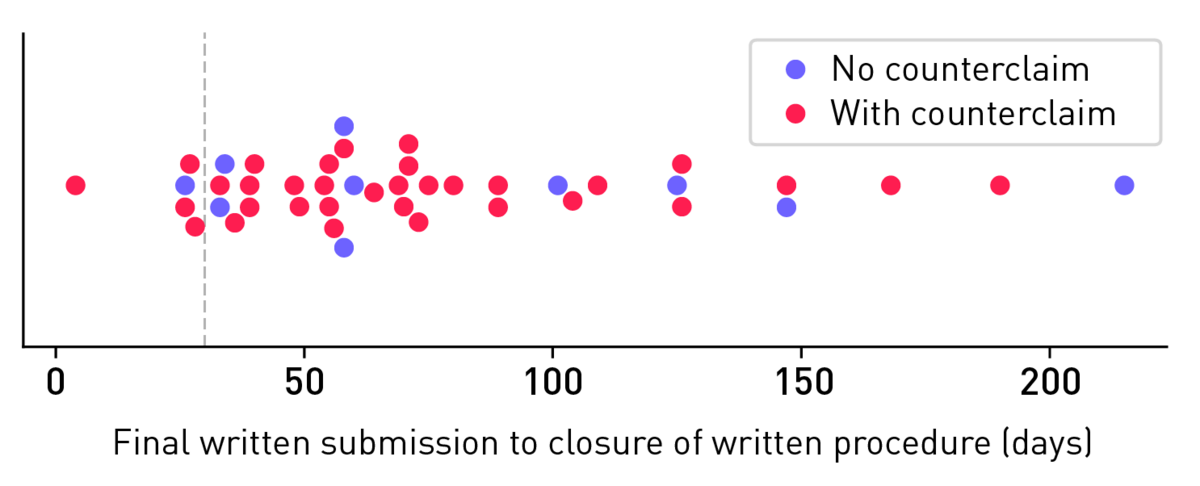
It should be noted that many cases with a counterclaim for revocation include an application to amend the patent, and therefore may include an additional written submission on month later than the date shown in the chart above. Nevertheless, many cases, including those with no counterclaim and therefore no application to amend, include a significant delay between the date of the final written submissions and the closure of the written procedure.
One possible explanation for this delay is that the Rules of Procedure don't specify when the written procedure should end. This is the one part of the overall timeline that is entirely within the UPC's control but does not have a specified or target duration. Perhaps it is being used by the local divisions to give themselves some breathing room without impacting their ability to hit the target for the interim procedure.
Assumption 2 seems to be at least partially holding true. Parties appear to be making the most of the short time periods for reply provided for in the Rules of Procedure. However, the time from service to the final written submission is in many cases longer than would be expected based on the deadlines set out in the Rules of Procedure:
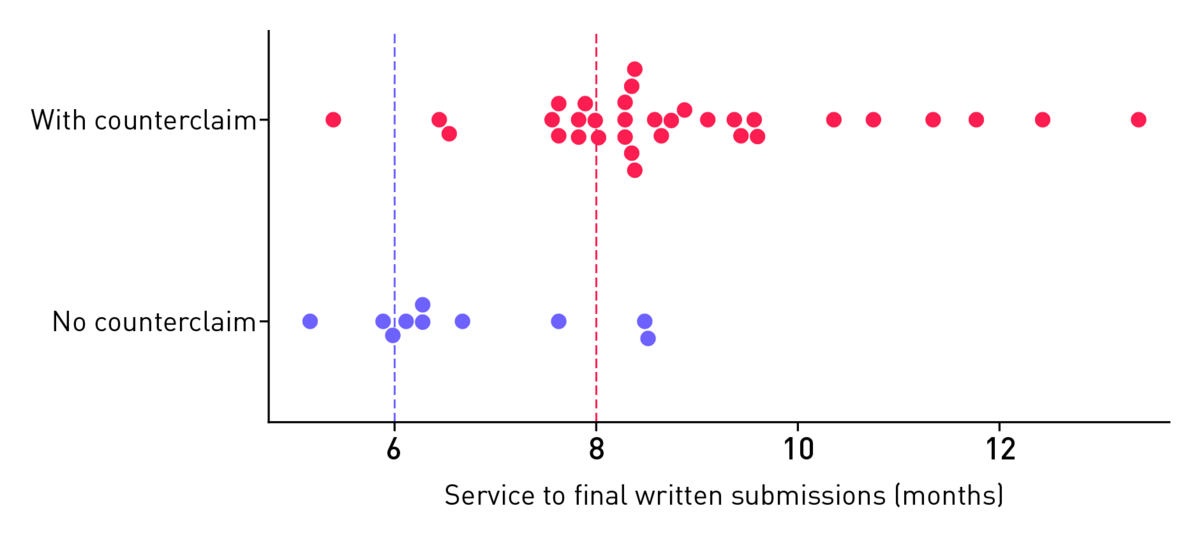
In infringement actions with no counterclaim for revocation, the maximum time envisaged by the Rules of Procedure between service of the statement of claim and filing the final written submissions is six months[8]. In an infringement action with a counterclaim, the maximum time envisaged by the Rules of Procedure is eight months[9]. While there are clear clusters of cases around the six- and eight-month lines in the chart above, in most cases the final written submission is filed significantly later than the theoretical "maximum". Without access to the pleadings in each case, it's difficult to say why the maximum was exceeded, but it is likely due to procedural issues such as changing the language of proceedings, which may result in some deadlines being re-set.
Assumption 3 is at least anecdotally holding true. Again, getting precise data on this from the CMS is not straightforward, but the general trend in published decisions and orders seems to be a strict approach to allowing further written submissions beyond those provided for in the Rules of Procedure.
Interim Procedure
According to the Rules of Procedure, the interim procedure should end no more than three months after the end of the written procedure[10]. As can be seen below, this target has been met or exceeded in almost every case so far.
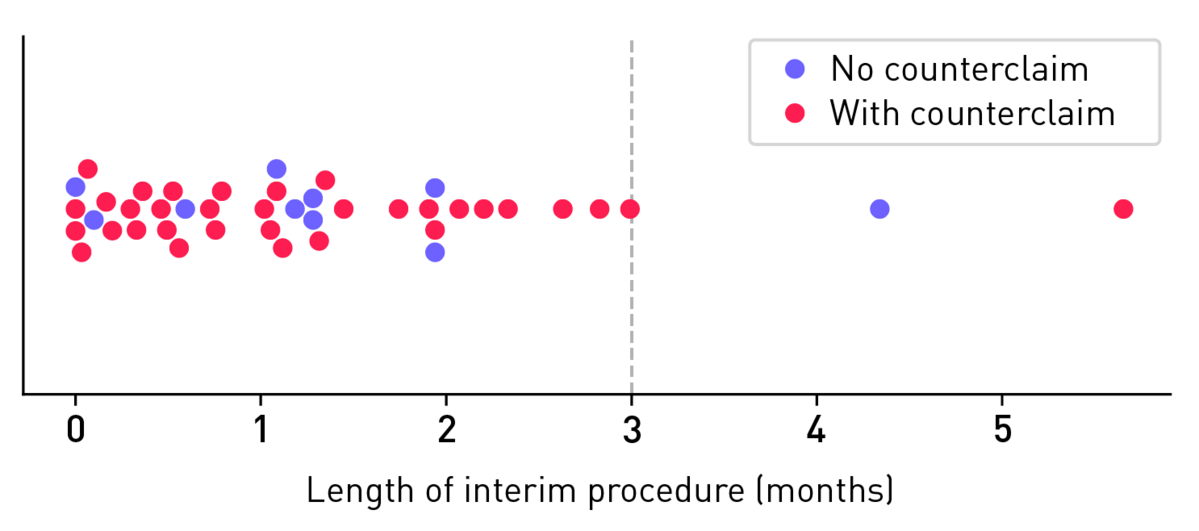
The efficiency of the interim procedure compared to the originally estimated 3 months makes up for much of the slowdown in the written procedure discussed above. As expected, the length of the interim procedure does not seem to be significantly affected by the filing of a counterclaim for revocation.
In most cases the interim procedure includes an interim conference, the aim of which is to identify the main issues and relevant facts that are in dispute and set a date for the hearing, amongst other things[11]. However, in some cases an interim conference is not held, which may significantly shorten the interim procedure.
As explained below, the end dates of the interim procedure shown in the CMS for some of the cases are manifestly incorrect. The outlier shown in the chart above at 172 days is one of those points. Furthermore, the cluster of cases close to zero suggests that the UPC has not been entirely consistent in its approach to the transition from written to interim procedure[12]. Indeed, in some cases it appears that someone at the UPC may have forgotten to officially close the written and/or interim procedures until a couple of days before the scheduled oral hearing.
Oral Procedure
The Rules of Procedure state that the oral procedure begins "[a]s soon as the judge-rapporteur considers that the state of preparation of the file is adequate" or on the last deadline for a party to take some action set during the interim procedure[13]. This already suggests that the beginning of the oral procedure will not coincide with the oral hearing, so the assumption that the length of the oral procedure would correspond to the targeted six weeks from hearing to decision was already shaky. Indeed, as can be seen below, in a clear majority of cases, the oral procedure lasts longer than the assumed six weeks:
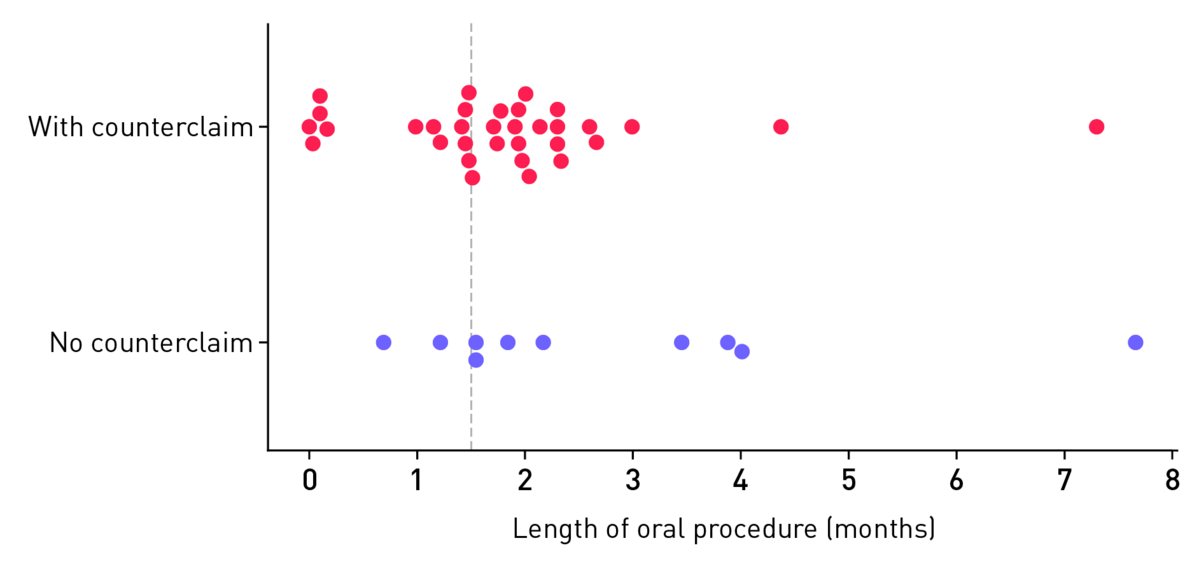
There is a cluster in the data with an oral procedure length of 0-5 days. In all of these cases, the date of the oral hearing listed in the UPC calendar is significantly before the date of closure of the interim procedure as indicated in the CMS. It's not clear what has gone wrong here—again, perhaps the relevant LDs simply forgot to formally end the interim procedure. In any event, in most cases the biggest factor affecting the length of the oral procedure is the time period between the oral hearing and issuance of the decision, as discussed in more detail above.
Service
The time required for service of the statement of claim on the defendant is generally not within the control of the court, but it is still useful to understand what the typical timeline is. We can talk about the timeline from service to the final decision as much as we like, but the reality is that filing the statement of claim is the real starting gun, at least for the claimant. If the typical time required for service is too variable, then the hard work required from both the court and the parties to reaching the final oral hearing in the targeted 12 months will be undermined.
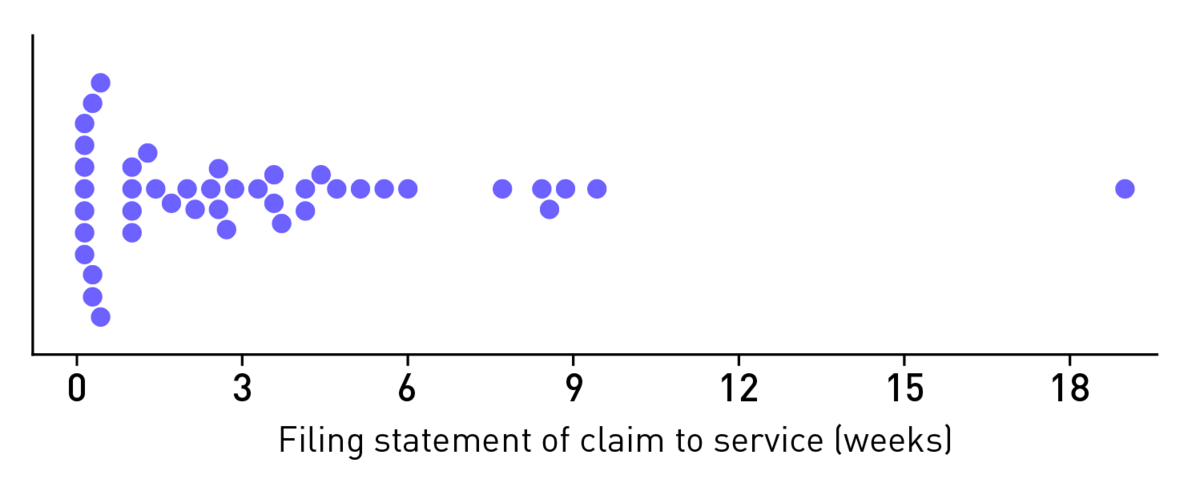
We have already seen that service outside the UPC contracting member states can be challenging, especially in China. Fortunately, with more than 50% of claims served within three weeks, service is not turning into a major bottleneck in most cases.
Differences Between Divisions
Given the significant differences in workload at the different local and regional divisions, it might be expected that the progress of cases at the busiest divisions would be slower. Furthermore, we have heard repeatedly that the German local divisions have difficulty composing panels of German-speaking judges for actions filed in German. Nevertheless, the differences between divisions do not appear to be significant, as shown below.
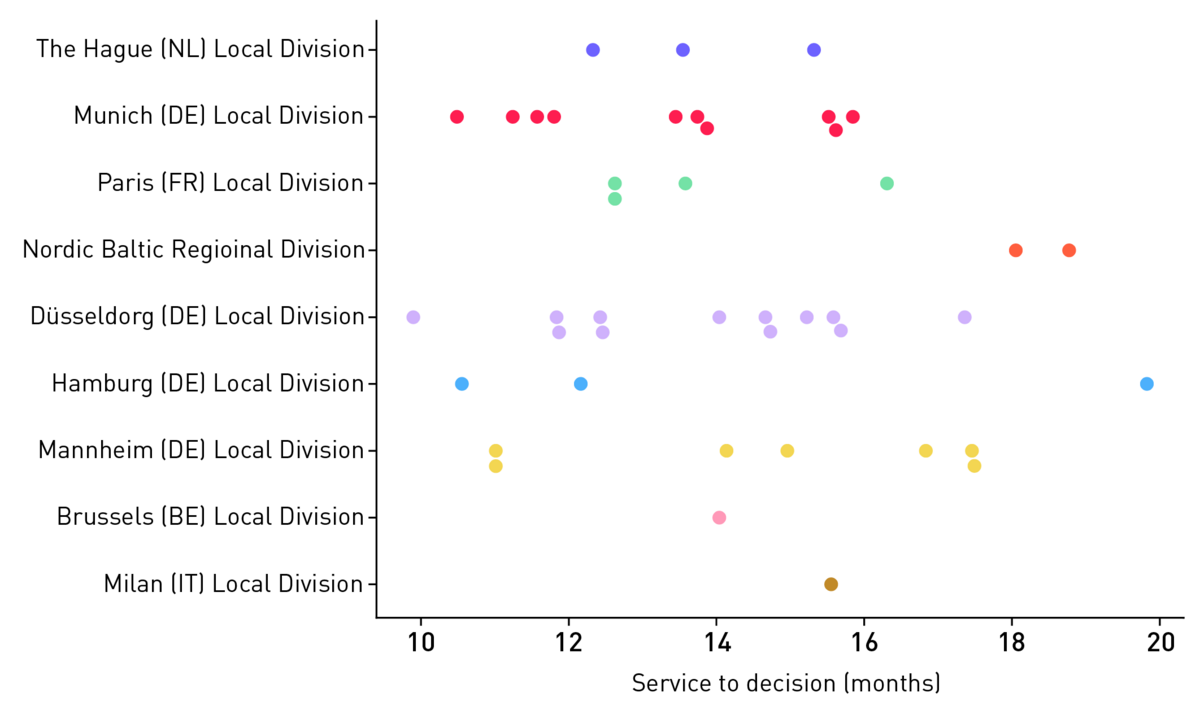
Given the very small sample sizes for many of the divisions, these statistics need to be taken with a large pinch of salt. However, it's clear that the German local divisions are not yet slowing down under their large workloads.
Conclusion
While the UPC is not quite hitting the specific targets of holding the final oral hearing with a year or issuing the decision within six weeks of the oral hearing in the majority of cases, it is coming very close. Some of the assumptions that were made before the court started operating have turned out to be false, but these have not led to a very large difference in the overall time from service to the final decision. And despite missing these targets, it's fair to say that the UPC is still providing a fast and efficient process in first instance infringement actions.
[1] Preamble 7 RoP.
[2] While the preamble to the RoP doesn't say "within one year of service", this can only be what was meant. In many cases, especially those that rely on the Hague Convention for effecting service on defendants domiciled outside the UPC contracting member states, the length of time from filing the statement of claim with the UPC and the date of service is unpredictable and very much out of the court's hands.
[3] Rule 118.6 RoP.
[4] Edwards v. Meril, UPC_CFI_380/2023, as we reported here: https://eip.com/uk/latest/article/edwards-v-meril-the-interaction-of-parallel-upc-and-epo-proceedings/
[5] Based on the mean (14.1 months) ± one standard deviation (2.4 months), which covers 2/3 of the sample.
[6] Unfortunately, applications to amend the patent do not appear in the list of cases related to the main infringement action in the old UPC CMS, so it isn't straightforward to further classify the actions with a counterclaim into those with an application to amend and those without. This seems to be due to a glitch in the old CMS, which doesn't reliably create the workflows for applications to amend in an infringement action with a counterclaim for revocation.
[7] These are i) the Statement of Claim, ii) the Statement of Defence, iii) Reply to the Statement of Defence, and iv) Rejoinder to the Reply. This chain of four submissions, two from each party, apply in each of the infringement action, the possible counterclaim for revocation, and the possible application to amend the patent.
[8] Statement of defence (3 months from service), reply to the statement of defence (+2 months), rejoinder to the reply to the statement of defence (+1 month).
[9] Statement of claim in the revocation action (3 months from service), defence to the counterclaim (+2 months), reply to the defence to the counterclaim (+2 months), rejoinder to the reply (+1 month). Note that the date of final written submissions for actions with a counterclaim in the chart is the date of the rejoinder to the reply to the defence to the counterclaim, so the potential missing month for a rejoinder in a possible application to amend is not relevant.
[10] Rule 101.3 RoP: "[w]ithout prejudice to the principle of proportionality, the judge-rapporteur shall complete the interim procedure within three months of the closure of the written procedure" (R101.3).
[11] For a full list, see Rule 104 RoP, which sets out the "aim of the interim conference".
[12] For example, in ACT_19746/2024 (UPC_CFI_173/2024), the written procedure and interim procedure were closed on the same day, 3 days before the oral hearing.
[13] Rule 110 RoP

The Patent Strategist
Get expert insights and the top patent stories delivered straight to your inbox.